

Why Timing Matters More Than Ever
For a long time, law firms were forced to accept delays, blind spots, and incomplete medical histories as part of the job. Medical records arrived late, sometimes months late, and often after critical decisions had already been made. Intake decisions, case valuation, and settlement strategy all happened without the full picture.
SettLiT was built to change that.
At its core, litigation is about making smart decisions at the right moment. Those decisions are only as good as the data behind them. Getting the right health data at the right stage of a case is no longer a nice-to-have. It is how modern firms compete, scale, and win.
This article walks through the four key stages of a case and explains why different types of medical data matter at different moments, and how SettLiT was designed to support each one.
Stage 1: Enhanced Intake and Early Case Validation
The reality of intake
Intake is where most risk enters the system. Clients do their best, but they are rarely reliable historians. Stress, trauma, addiction, or years of treatment make it almost impossible for someone to remember every provider, diagnosis, or prescription.
Most clients list three or four providers at intake. The reality is often closer to forty or fifty.
When firms rely only on intake questionnaires, several things happen.
Strong cases are missed. Weak cases are accepted. Pre-existing conditions stay hidden. Credibility issues surface later, when they are much harder to manage. This is the root of the medical records bottleneck that slows so many firms.
What data actually matters at intake
At this stage, firms do not need every page of every medical record. What they need is clarity.
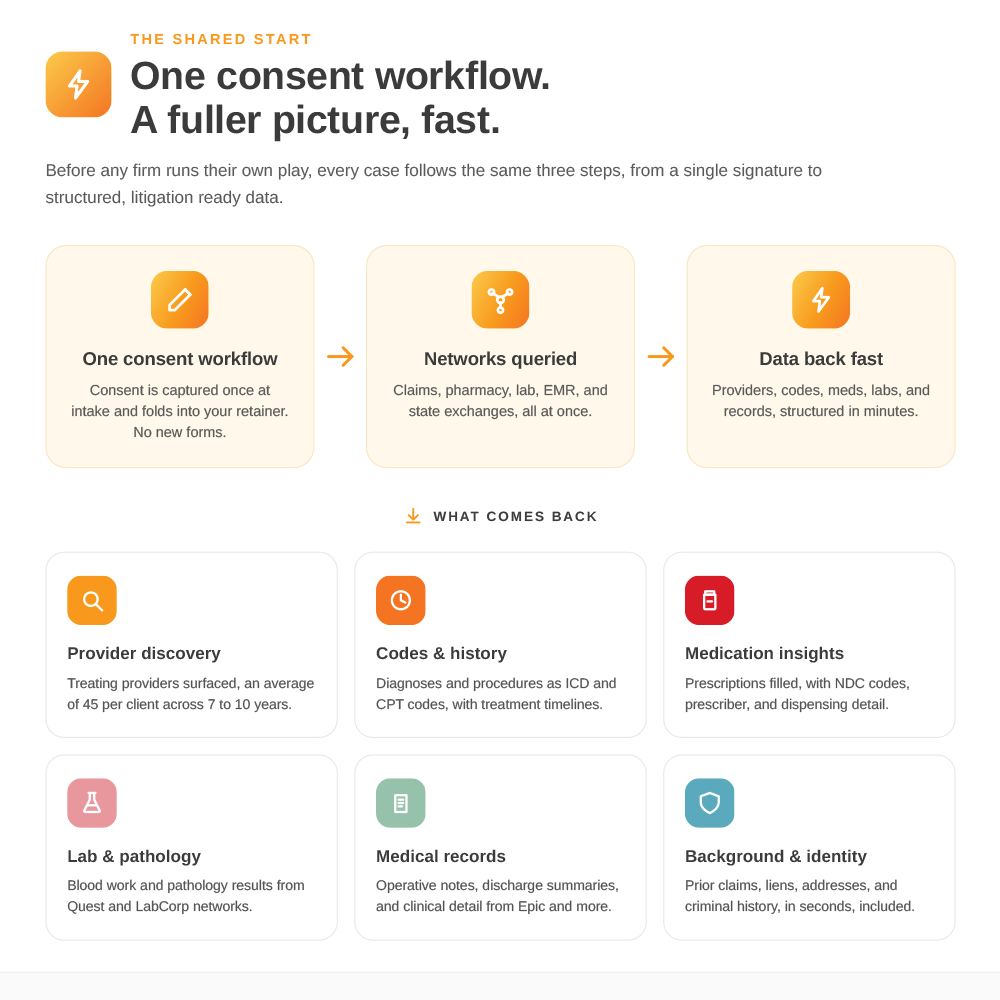
SettLiT delivers that clarity within minutes by surfacing identity confidence, address history, provider discovery, pharmacy and claims signals, and early red flags. In most cases, firms can see an accurate snapshot of a claimant's medical footprint in under five minutes.
This allows teams to validate the story, understand medical complexity, and make smarter accept or decline decisions before time and money are invested. For more on this approach, see our article on pre-litigation health data strategy.
Why SettLiT is different at intake
Traditional record retrieval cannot support intake decisions because it is too slow. By the time records arrive, the case is already in motion.
SettLiT flips that model. Instead of waiting weeks for information, firms start with verified medical data and build forward.
The result is faster intake, fewer bad cases, and stronger pipelines.
Stage 2: Uncovering Medical Priors Before They Become Problems
Where cases often break down
Pre-existing conditions are one of the most common pressure points in both personal injury and mass tort cases. Defense counsel will find prior injuries, diagnoses, or treatment history. The only question is whether they find it before you do.
Surprises at deposition or mediation weaken leverage and damage credibility.
The data firms need at this stage
Before depositions, discovery, or settlement discussions, firms need visibility into treatment timelines, prior injuries, mental health history, and medication use. This includes proof of dispensed medications, not just what was prescribed.
SettLiT pulls this information from claims data, pharmacy networks, lab systems, and electronic medical records. Most of this data spans seven to ten years and is delivered far faster than traditional methods. Understanding how law firms access medical records today helps explain why this speed advantage matters.
How SettLiT changes case preparation
Instead of reacting to defense discoveries, firms using SettLiT prepare proactively. Attorneys can walk into depositions knowing exactly what is in the record and how to address it.
That confidence translates directly into stronger negotiations and better outcomes.
Stage 3: Automated Case Management That Keeps Cases Moving
The operational bottleneck
Even when firms have good data, operational friction slows everything down. Manual uploads, duplicate data entry, and disconnected systems create delays that compound across large dockets.
Turning data into momentum
SettLiT integrates directly with case management systems like Filevine and SmartAdvocate and also supports enterprise API workflows. Provider lists, medical records, and structured data flow directly into case files without manual handling.
This allows legal teams to focus on strategy instead of administration and makes it possible to manage high-volume litigation without adding staff. See our webinar for a live demonstration of how this works.
Why this matters
When data moves automatically, cases move faster. Deadlines are easier to hit. Teams stay aligned. Operations scale cleanly.
Stage 4: Accelerated Settlement and Better Leverage
Why speed affects value
Settlement value erodes with delay. The longer a case drags on, the more leverage shifts away from the plaintiff.
The right data at the finish line
SettLiT provides verified medical timelines, proof of injury, structured outputs, and court-ready documentation that firms can rely on during mediation and settlement discussions.
With the full medical picture in hand, firms negotiate from a position of strength and resolve cases faster. For mass tort case types, this acceleration is especially critical at scale.
The bigger picture
SettLiT is not just about speed. It is about control. Firms that control their data control their timelines and outcomes. Learn about the evolution of health data access that made this possible, and our security and compliance practices that keep it safe.
.svg)

.png)