.png)

A fragmented system
Accessing medical records has always been complicated. Over time, law firms adopted multiple methods out of necessity, not because they worked well.
Understanding the limitations of each method helps explain why the industry has been overdue for change, and why the evolution of health data access matters so much.
Traditional access methods
Physical records, fax, phone calls, and mail dominated medical record retrieval for decades. These methods are slow, labor intensive, and unpredictable. Turnaround times often stretch from weeks into months, with little transparency and mounting costs.
Email and PDF delivery improved speed slightly but introduced new problems. Data arrived unstructured, security risks increased, and teams still had to manually review and organize everything.
Patient portals helped patients but did not solve legal workflows. Coverage is incomplete, formats vary, and completion rates are inconsistent.
The cumulative effect is the medical records bottleneck that plagues most PI and mass tort firms.
Modern digital access methods
State health information exchanges improved regional access and lowered costs, but they stop at state borders and vary widely in responsiveness.
National health exchanges and QHINs finally enabled interoperability, but for years legal access was not allowed.
Direct EMR integrations provide clinical-grade documentation, but they require site-by-site enablement and are difficult to manage at scale.
Patient-directed and individual access
Individual access was designed to empower patients, but until recently it was fragmented and impractical for law firms.
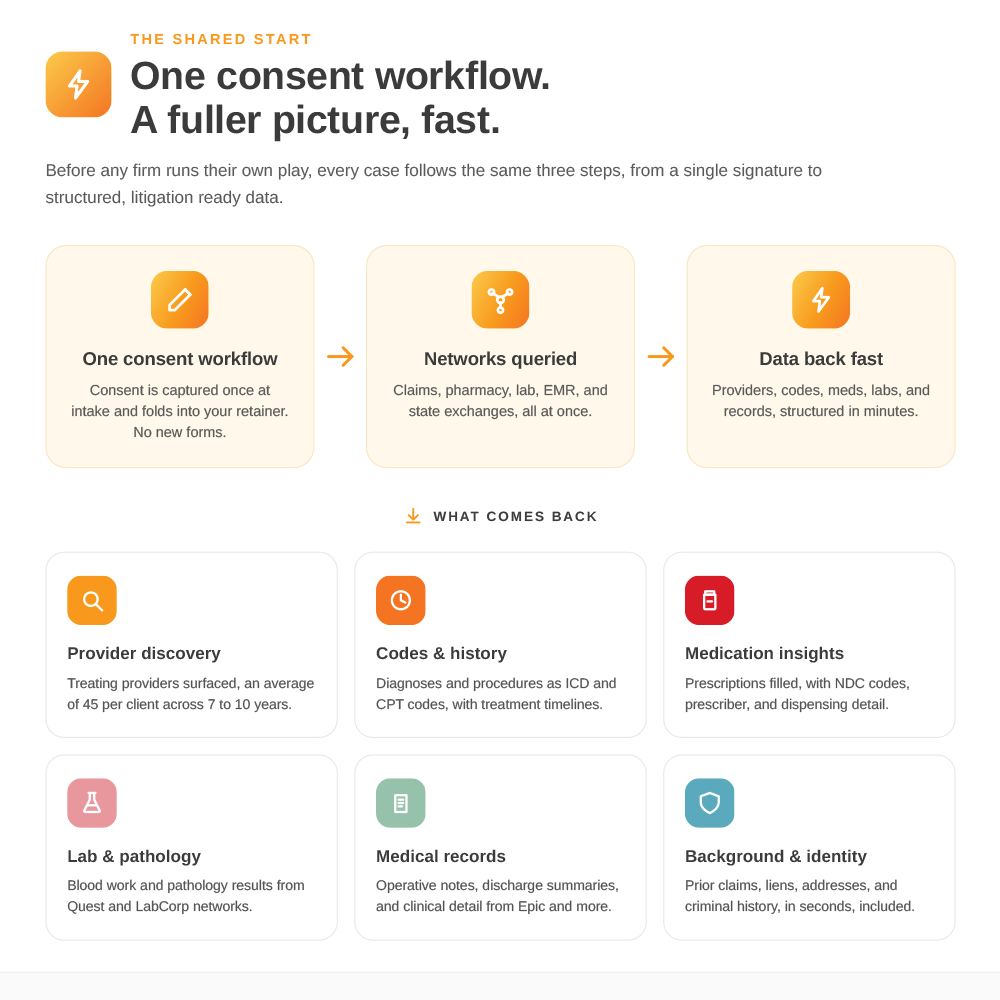
SettLiT is the first platform approved to use CLEAR identity verification for legal medical record access nationwide. Clients verify their identity in minutes, and records return in under ten minutes in many cases.
Why SettLiT succeeds where others fail
SettLiT brings every access method together into a single, compliant system. Digital networks, state exchanges, national exchanges, EMRs, individual access, and physician-led retrieval all live in one workflow.
Firms pay flat fees, avoid per-page costs, and only pay when data is actually returned.
The result is simplicity, speed, and confidence. For mass tort qualification workflows, this unified approach is essential at scale. Getting the right data at the right time becomes the default rather than the exception.
To see how this works in practice, watch our From Data to Decisions webinar. Learn about our security and compliance practices that make this possible, and how a strong pre-litigation health data strategy changes case outcomes.
.svg)
.png)