.png)

The Bottleneck Everyone Has Felt
If you spend any time inside a personal injury or mass tort practice, you already know this tension. Medical records sit at the center of nearly every decision, yet accessing them remains one of the least predictable parts of the workflow.
Medical records determine case viability. They shape damages models. They influence settlement leverage. And still, even in a largely digital healthcare system, retrieval is often slow, fragmented, and inconsistent.
This is not a staffing issue. It is not a diligence issue. It is an infrastructure issue.
Why Medical Record Retrieval Is Still Broken
The release process was built for a different era. Faxed authorizations, mailed requests, and provider-by-provider follow ups were manageable when case volumes were lower and timelines more flexible.
Today, a single claimant may have treatment across hospitals, specialists, imaging centers, pharmacies, labs, urgent care clinics, and telehealth providers. Each entity operates under its own workflow, turnaround times, and interpretation of authorization requirements. Understanding the evolution of health data access helps explain how we got here.
For experienced legal teams, that creates three persistent challenges.
Long and unpredictable timelines. Incomplete provider identification. And a high administrative burden that pulls staff away from strategic legal work.
Even firms with strong internal operations feel this drag. The model itself does not scale cleanly.
The Real Cost to Law Firms
The impact goes well beyond inconvenience.
When records are delayed or incomplete, intake teams qualify claims with partial visibility. Attorneys spend time chasing down missing providers instead of refining case theory. Settlement discussions stall while waiting for confirmation of treatment details.
In mass tort litigation, these issues multiply across hundreds or thousands of claimants. What looks like a minor delay in a single file becomes material business risk at scale. See mass tort case types for how this plays out across different dockets.
The firms that consistently outperform are not just better litigators. They are better operators. They move earlier and with greater certainty because they see the medical picture sooner. A strong pre-litigation health data strategy is central to that advantage.
Why Incremental Fixes Fall Short
Many firms attempt to patch the problem. They outsource retrieval. They add internal tracking systems. They build larger support teams.
Those efforts may reduce friction, but they do not eliminate the core constraint.
Manual retrieval remains reactive. Provider variability remains unpredictable. Legacy retrieval vendors were not designed for high-volume litigation, integrated case management systems, or data-driven qualification workflows. For context on why traditional methods struggle, see how law firms access medical records today.
What firms need is not a faster fax process. They need a fundamentally different model for discovering, accessing, and validating medical data.
SettLiT's Digital, Consent-Driven Approach
SettLiT approaches medical record retrieval from the front end.
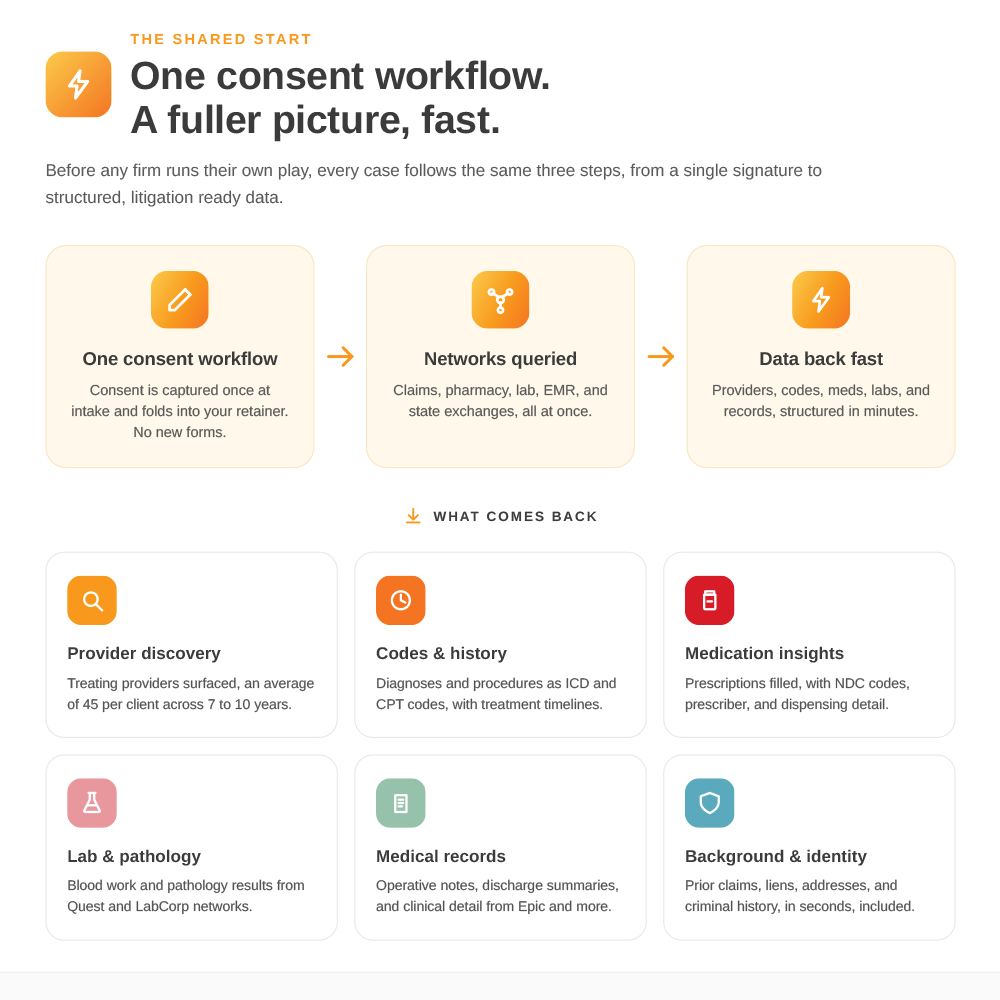
Instead of starting with record requests, SettLiT begins with provider discovery and medical data access. The platform identifies where a claimant has received care, validates authorization once, and retrieves records through digital health networks whenever possible.
That shift changes the workflow in practical ways.
Firms gain early visibility into the full provider universe. Digitally available records can be accessed without waiting on manual processing. Teams see clearly what has been retrieved and what remains outstanding.
The difference is control. Instead of chasing records, firms operate with structured insight.
What This Means for Personal Injury Firms
For personal injury practices, earlier visibility into treatment history means faster case qualification and more confident demand packages. Pre-existing conditions can be identified before deposition. Medication history can be validated before mediation. When the right data arrives at the right time, case strategy starts from evidence.
What This Means for Mass Tort Firms
For mass tort operations, the impact is even more pronounced.
Exposure can be confirmed earlier. Diagnosis codes can be validated sooner. Weak cases can be filtered out before capital and expert resources are deployed.
When screening thousands of claimants, speed and precision are not conveniences. They are financial safeguards.
A Competitive Shift in Legal Operations
Medical records will always be central to injury litigation. What is changing is how firms access and operationalize them.
Firms that rely entirely on fragmented, manual retrieval models will continue to absorb delay and administrative drag. Firms that adopt digital, consent-driven medical record retrieval gain predictability, speed, and strategic clarity.
SettLiT is not positioned as a marginal efficiency tool. It is infrastructure for firms that expect medical data to move at the pace of their cases. Watch our webinar to see this in action.
Rethinking Medical Record Retrieval
If your firm is still waiting weeks or months for critical medical records, the issue is not effort. It is structure.
Talk to SettLiT to see how digital provider discovery and modern medical record retrieval can reduce bottlenecks, accelerate intake, and strengthen case evaluation. Learn about our security and compliance practices that make this possible.
The faster you see the full medical picture, the faster you can move with confidence.
.svg)

.png)