.png)

Why Understanding Mass Tort Categories Matters
Mass tort firms know that no two dockets operate the same way. Teams handling pharmaceutical and medical device cases are already deeply familiar with the nuances, medical complexity, and procedural demands that come with each category.
What continues to evolve, however, is the operational pressure around scale. Larger claimant pools, tighter court deadlines, more aggressive defense strategies, and increasing data complexity mean that even experienced firms are constantly refining how they qualify cases, prove exposure, and manage costs across dockets.
While pharmaceutical and medical device cases share some structural similarities, the way exposure is established, injuries are documented, and records are sourced differs in meaningful ways. Understanding those differences is not about education, it is about execution.
This article focuses on how those differences show up operationally, and how modern mass tort firms use medical data infrastructure to stay fast, precise, and in control.
Pharmaceutical Mass Torts: Patterns, Proof, and Practical Challenges
Pharmaceutical mass torts typically center on long-term drug use, side effects, contamination, or failures to warn. These cases often involve years of prescriptions, multiple manufacturers, evolving scientific theories, and shifting regulatory guidance.
Common examples include widely used consumer products like talcum powder, long-term maintenance drugs such as PPIs, recall-driven litigations like Zantac or Valsartan, and newer therapies such as GLP-1 agonists where injury patterns are still emerging.
Across these cases, firms are usually working to answer a consistent set of operational questions.
Did the claimant actually take the drug? Was it dispensed at a pharmacy or merely prescribed? Over what time period? Did usage align with known risk windows, contamination periods, or labeling changes? And does the medical record support the alleged injury, whether that is cancer, organ damage, addiction, or neurodevelopmental harm?
Where pharmaceutical cases get difficult
In cases like talc or PPIs, exposure may span decades and involve countless pharmacies and providers. In Zantac and Valsartan matters, liability often turns on specific manufacturing periods, NDMA contamination, or product degradation timelines. Opioid-related cases may require proof of long-term use, prescribing patterns, and addiction treatment history across multiple systems.
Clients often remember the product name but not the pharmacy, dosage history, or prescribing provider. Records are fragmented across insurers, pharmacy benefit managers, and states, creating a medical records bottleneck that slows qualification.
How SettLiT supports pharmaceutical mass torts
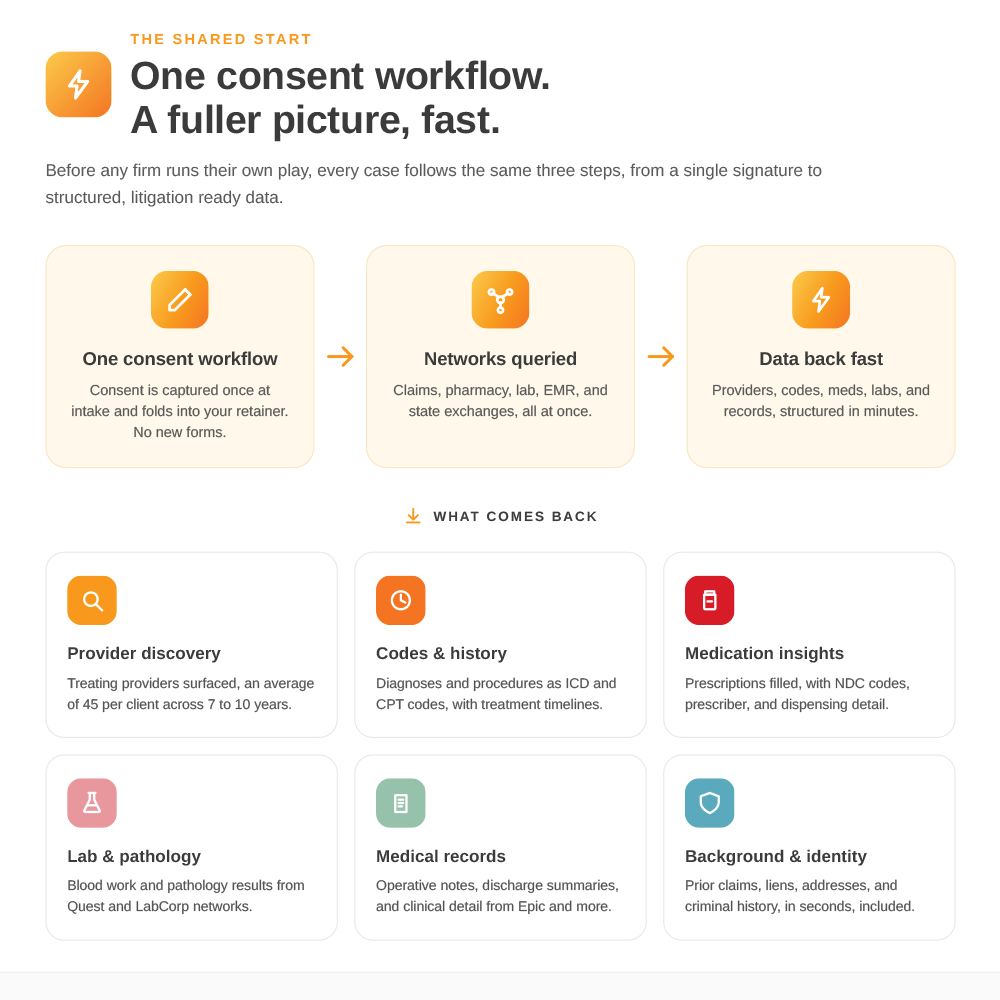
SettLiT gives firms direct access to pharmacy benefit managers, national pharmacy networks, claims clearinghouses, lab systems, and electronic medical records. This allows teams to confirm dispensed medications using NDC codes, identify treatment duration, and surface diagnosis codes tied to the alleged injury.
For example, firms working Zantac or Valsartan cases can quickly validate whether a claimant actually filled the drug during relevant contamination windows. In opioid or Suboxone matters, pharmacy and claims data help establish treatment patterns and duration. In talc or Depo-Provera cases, claims and lab data help corroborate long-term exposure and downstream diagnoses.
Instead of waiting weeks for piecemeal records, firms can validate or disqualify cases early, focus resources on viable claims, and build stronger proof packages for qualified plaintiffs.
Medical Device Mass Torts: Design Defects, Failures, and Surgical Records
Medical device cases tend to be more procedure-driven than pharmaceutical matters. The central questions usually revolve around implantation, device identification, failure modes, and surgical outcomes.
Common examples include hernia mesh, IVC filters, hip and knee implants, Paragard IUDs, surgical staplers, cardiac support devices like Impella pumps, and warming systems such as Bair Hugger. In gynecological cases, morcellators and long-term implantable devices often feature prominently.
In these matters, firms are typically working to establish whether the device was implanted, which model or generation was used, when implantation and any revision surgeries occurred, and whether the complications align with known device defects or failure patterns.
Where device cases get challenging
Patients rarely know the exact device name, manufacturer, or model number. That information lives deep in operative reports, hospital records, and surgical notes. In hernia mesh or hip implant cases, injuries may surface years after the original surgery, requiring firms to reconstruct long medical timelines across multiple facilities.
Defense strategies often hinge on narrowing exposure to specific devices or versions. For example, differentiating between metal-on-metal hip implants versus later designs, or identifying whether an IVC filter fractured or migrated. Understanding how law firms access medical records today explains why this retrieval process is so difficult.
Traditional record retrieval makes this process slow, especially when surgeries occurred years earlier or at facilities that have since merged, closed, or changed record systems.
How SettLiT supports medical device mass torts
SettLiT helps firms locate surgical encounters, identify treating facilities, and surface procedure codes and operative timelines early in the case lifecycle. Claims and EMR data provide early indicators of implant procedures, revisions, infections, and complication patterns.
For example, firms working hernia mesh or hip implant cases can quickly identify surgical encounters and follow-on revision procedures. In Paragard cases, procedure and visit data help confirm insertion and removal attempts. In IVC filter or Impella matters, claims and hospital data help establish implantation, complications, and related hospitalizations.
By confirming device exposure sooner, firms reduce intake friction, avoid investing in cases that cannot be substantiated, and move qualified cases forward with greater confidence. Getting the right data at the right time is what separates efficient dockets from costly delays.
Shared Themes Across All Mass Torts
While pharmaceutical and device cases differ, successful mass tort firms consistently focus on a few operational priorities.
Early qualification to avoid wasted spend. Reliable proof of exposure and injury. Scalable workflows that can handle thousands of claimants. And defensible documentation that stands up to court scrutiny.
SettLiT was built to support these exact needs.
By unifying pharmacy data, claims data, lab results, EMRs, identity enrichment, and physician-led retrieval into a single platform, SettLiT gives firms the medical data they need to move faster without cutting corners. Learn more about our security and compliance at SettLiT.
How Modern Mass Tort Firms Use SettLiT
Firms use SettLiT to screen large claimant pools, verify qualifying criteria, and meet court deadlines without waiting months for traditional records. Many start with lower-cost digital signals and only escalate to deeper retrieval when needed.
This approach reduces risk, improves margins, and allows firms to scale mass tort operations with confidence. Watch our webinar to see how this works in practice.
Final Takeaway
Mass tort litigation is no longer just about volume. It is about precision.
Firms that can quickly connect exposure, injury, and timelines using reliable medical data will continue to outperform those relying on manual workflows and delayed records.
SettLiT helps mass tort firms operate with clarity, speed, and control at every stage of the docket.
.svg)

.png)