.png)
Confirm the Lymphoma. Then Prove the Timeline.
Surface dupilumab dispensing history, cutaneous T-cell lymphoma diagnoses, and the pre-treatment dermatology record across your Dupixent docket
Dupixent (dupilumab) litigation is one of the newest mass torts of 2026. On June 5, 2026, the Judicial Panel on Multidistrict Litigation centralized the federal cases in the District of New Jersey as MDL No. 3180, before Judge Zahid N. Quraishi. The lawsuits allege that Sanofi and Regeneron failed to warn that their blockbuster biologic, prescribed for eczema, asthma, and other inflammatory conditions, can cause or accelerate cutaneous T-cell lymphoma (CTCL), and failed to instruct physicians to monitor for it.
Every claim turns on two things: documented Dupixent use and a confirmed T-cell lymphoma diagnosis. But there is a third, decisive question the defense will press hardest. When did the skin disease actually start? CTCL is routinely misdiagnosed as eczema for years before it is correctly identified, which is exactly the population Dupixent was prescribed to. Establishing whether the lymphoma developed after dupilumab or pre-existed it requires the complete dermatology and biopsy history, not the intake narrative.
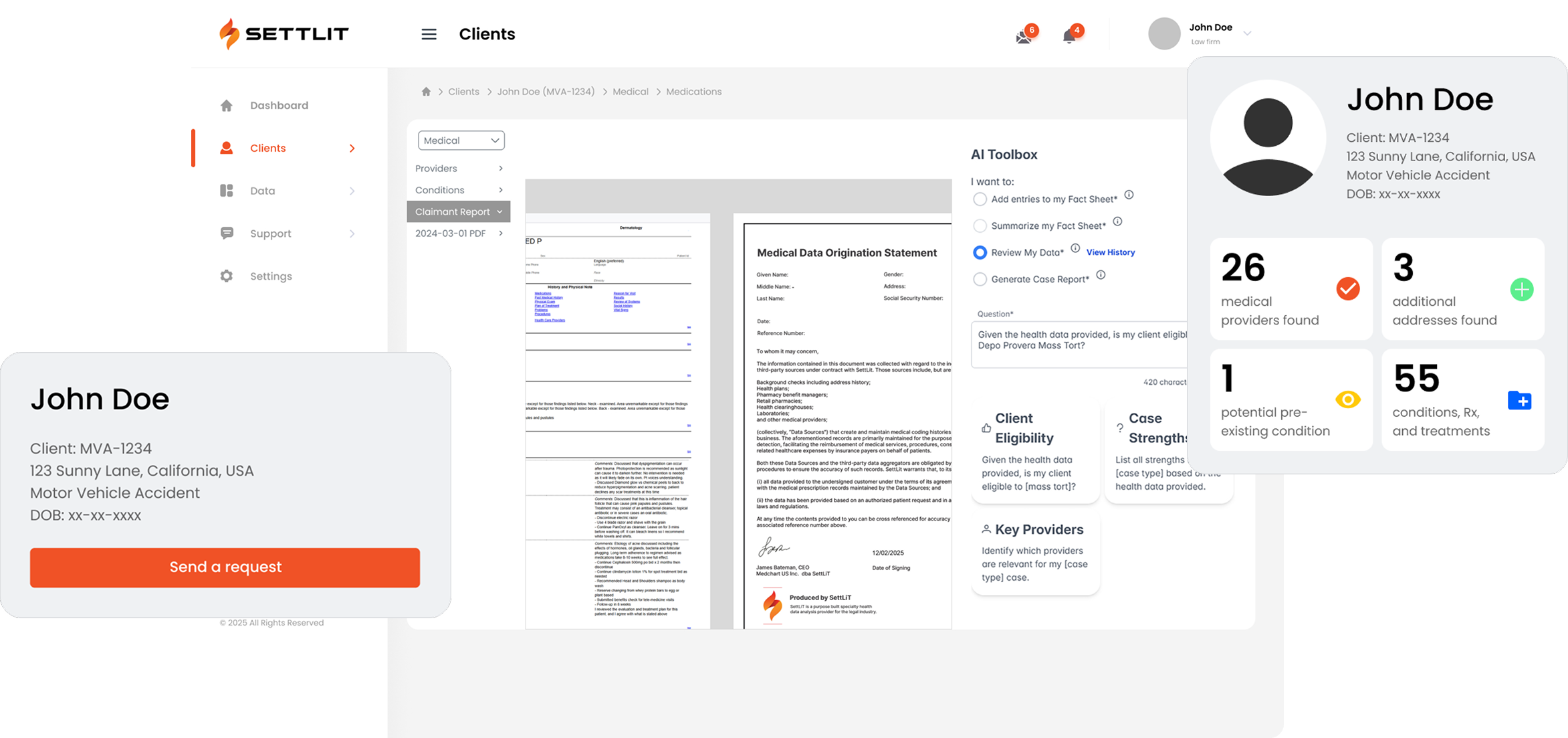
SettLiT provides the digital health data that helps firms qualify Dupixent claimants earlier, verify dispensing history through pharmacy benefit data, and reconstruct the dermatology-to-oncology timeline before record retrieval begins.
What Makes Dupixent Qualifcation Operationally Demanding
Dupixent claims require firms to establish dupilumab use, a T-cell lymphoma diagnosis, and a defensible timeline between the two. Claimants were treated for chronic skin conditions across dermatologists, allergists, and primary care offices, often for years, and the records that distinguish a drug-induced lymphoma from a pre-existing, long-misdiagnosed one are rarely in hand at intake.

inCOMPLETE INTAKE NARRATIVES
Claimants rarely remember every dermatologist, allergist, and clinic that treated their eczema or asthma before the diagnosis. SettLiT finds the providers, and the labs that ran the early biopsies, that your client forgot.

the misdiagnosis timeline problem
CTCL is often mistaken for eczema for years before it is correctly diagnosed. The pre-Dupixent dermatology and biopsy history is what separates a qualifying case from a contested one, and it takes weeks to assemble manually.

CAPITAL DEPLOYED TOO EARLY
Firms fund case workup before confirming the dispensing timeline and diagnosis line up. In an early MDL, cases that fall short still absorb the full cost.

LATE LITIGATION
SURPRISES
Defense finds earlier skin symptoms, prior biopsies, or an alternative diagnosis you never saw. With a pre-existence defense expected, an incomplete pre-treatment record is your biggest exposure.
Verify the Timeline Before You Build the Case
The firms building stronger Dupixent dockets are not starting with retrieval. They are starting with health data: structured records that confirm the dispensing timeline, the diagnosis, and the pre-treatment dermatology picture before resources are committed.
What SettLiT Surfaces in Dupixent Cases
SettLiT connects to national health data networks and structured medical datasets to surface the signals that matter in Dupixent litigation.
These may include:

Dupilumab (Dupixent) dispensing records with NDC codes, fill dates, and duration of use

CTCL diagnoses such as mycosis fungoides, Sézary syndrome, and other cutaneous T-cell lymphoma codes

Treating providers across dermatology, allergy and immunology, and hematology-oncology

Other T-cell lymphoma diagnoses captured by distinct claims codes, supporting cases the MDL may add through conditional transfer

Diagnostic and treatment encounters including skin biopsies, flow cytometry, TCR gene-rearrangement testing, phototherapy, systemic therapy, and radiation
Mapping Data to Dupixent Eligibility
Dupixent claims require documented dupilumab use and a confirmed T-cell lymphoma diagnosis, with a timeline that withstands a pre-existence defense. SettLiT maps directly to the evidentiary requirements:

Dupilumab Dispensing History
Pharmacy benefit data returns Dupixent and dupilumab dispensing records with NDC codes and fill dates, establishing duration and continuity of use.

T-Cell Lymphoma Diagnosis (Both Theories)
Claims data carries distinct diagnosis codes for cutaneous T-cell lymphoma (mycosis fungoides, Sézary syndrome) and for other T-cell lymphomas, so a firm can prove either the core MDL theory or the conditions likely to be added later.

Pre-Treatment Dermatology Timeline
Encounter and claims history surfaces the earliest documented skin-disease diagnoses and biopsies, establishing whether the lymphoma followed dupilumab or predated it.
A New MDL. The Cases Are Being Built Right Now.
MDL No. 3180 was centralized in June 2026 with roughly two dozen cases and tag-along actions already identified. At this ground-floor stage, qualification discipline decides which firms build a clean, defensible docket and which inherit timeline problems later.
Every Dupixent case rests on one claimant's dispensing history, one lymphoma diagnosis, and one dermatology timeline that either supports the claim or invites a pre-existence defense. SettLiT surfaces that picture at scale, with health data across every claimant you screen, so qualification decisions are grounded in verified records rather than intake recall.
Confirm the Diagnosis Before You Commit
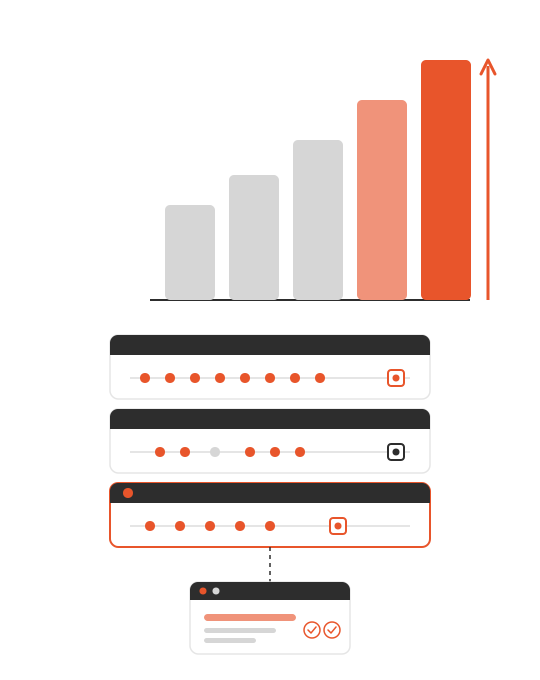
Dupixent qualification hinges on a confirmed T-cell lymphoma diagnosis tied to documented dupilumab use. At intake, a claimant knows they had cancer and were on Dupixent, but the specific lymphoma subtype, the diagnosis date, and the treating oncology team are rarely in the file.
SettLiT surfaces CTCL and T-cell lymphoma diagnosis codes from claims data, alongside dupilumab dispensing records, before retrieval begins. Know whether the diagnosis and the use history line up before you invest in case workup.

Find It Before Sanofi and Regeneron Do
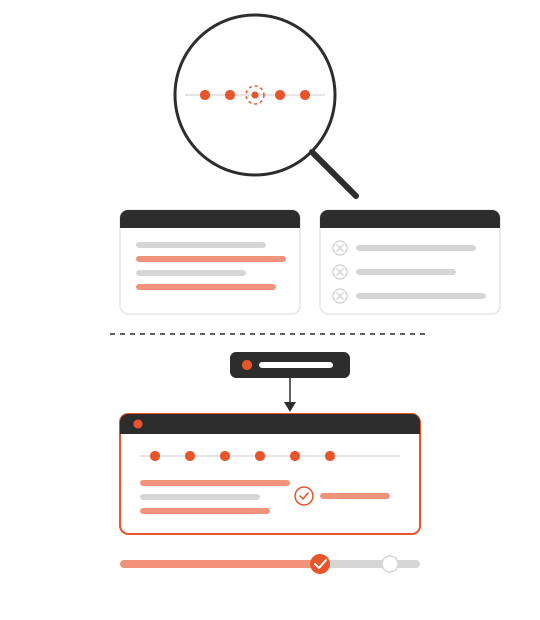
Sanofi and Regeneron are expected to argue that the lymphoma pre-existed Dupixent and was simply unmasked once treatment began, a defense made credible by how often CTCL is misread as eczema for years. Defense teams will scrutinize the pre-treatment dermatology record, hunt for earlier biopsies, and look for alternative diagnoses. The question is whether you find these issues first.
SettLiT gives your team the same visibility into the claimant's medical history that the defense will eventually obtain. Identify the timeline complications early. Adjust strategy before you commit resources. Build cases that survive scrutiny from day one.

Why Firms Choose SettLit For Dupixent Qualification

digital health Data First
Surface dupilumab dispensing records and lymphoma diagnoses before retrieval begins.

Provider discovery
Identify dermatologists, allergists, primary care providers, and hematologist-oncologists across the claimant's full care history.

structured medical outputs
Receive NDC-coded dispensing records, diagnosis codes, and treatment timelines in formats built for Dupixent litigation workflows.

Targeted retrieval enablement
Focus retrieval on the pathology labs and oncology practices most likely to produce the biopsy and treatment records that advance the case.
Scalable docket workflows
Process thousands of Dupixent claimants with the same rigor you would apply to one.
Integration Ready Infrastructure
API and portal access. Integrates with Filevine and Smart Advocate.
.svg)
.svg)
.svg)
.svg)
.svg)
.svg)