.png)
Talc Claims Require Oncological Proof. Verify It Before You Commit.
Surface ovarian cancer diagnoses, gynecological treatment history, and provider networks across your talc docket
Talc litigation is one of the largest mass torts in U.S. history, with over 67,000 cases pending in federal court as of March 2026. Each claim alleges that long-term use of talcum powder products caused ovarian cancer due to asbestos contamination. The medical foundation of every case depends on a verified diagnosis, a documented treatment history, and a provider network that defense cannot challenge.
At intake, claimants know they have cancer. What they often cannot recall is every gynecologist, oncologist, surgical center, and infusion facility involved in their care. Reconstructing that history takes weeks through traditional retrieval, and the gaps leave cases vulnerable to defense challenges.
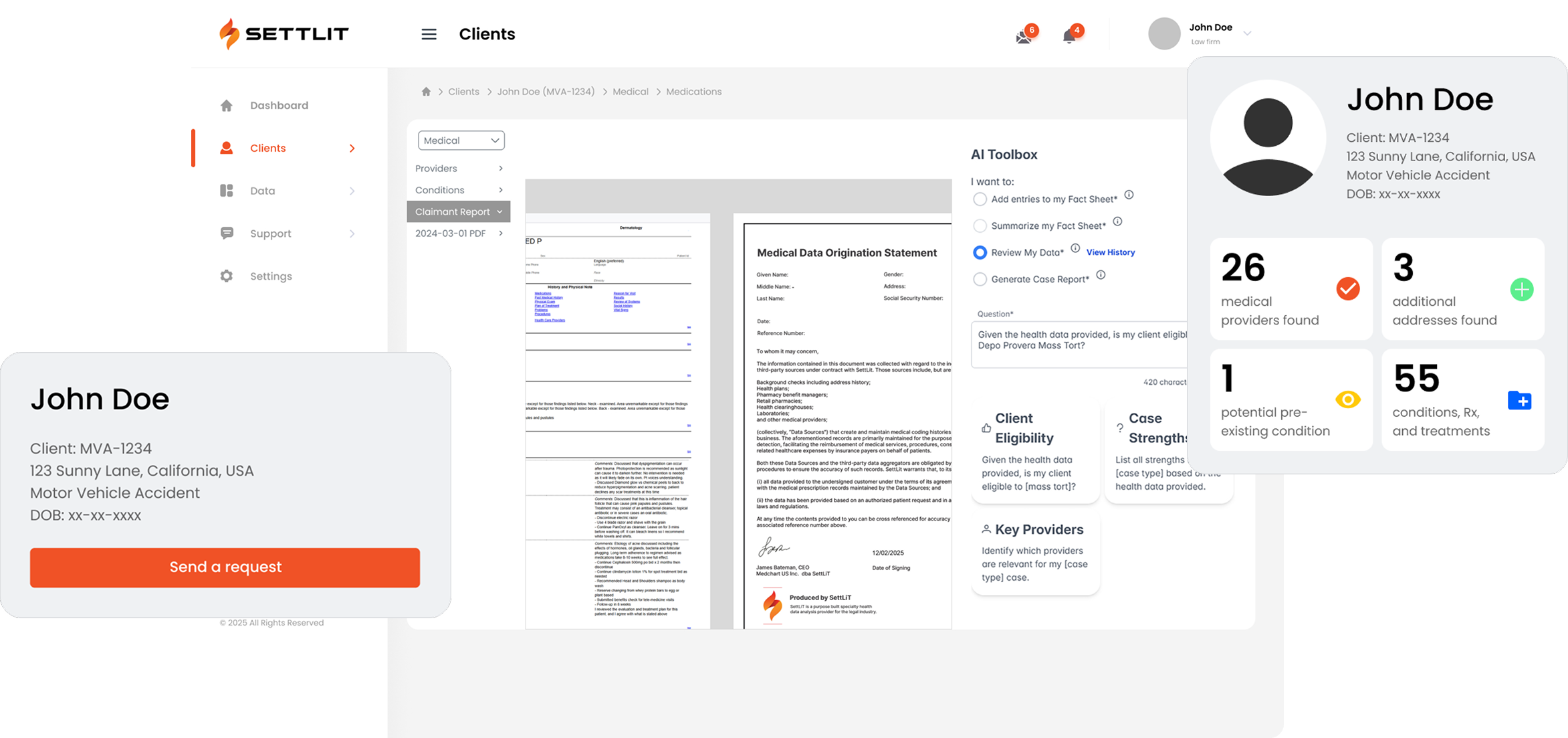
SettLiT provides the digital health data that helps firms qualify talc claimants earlier, surface the complete oncological picture faster, and deploy record retrieval strategically.
What Makes Talc Ovarian Cancer Dockets Operationally Demanding
Talc litigation requires firms to substantiate an ovarian cancer diagnosis, document a complete gynecologicaland oncological treatment history, and establish a credible product use timeline. The medical record is the foundation of every case, and at intake, it is almost never complete.

inCOMPLETE INTAKE NARRATIVES
Claimants diagnosed with ovarian cancer often received care across OB-GYN practices, gynecologic oncologists,hospital systems, and infusion centers over years of treatment. Reconstructing that history from a phone intake is unreliable and leaves critical gaps firms discover too late.

SLOW MEDICAL RECORD RETRIEVAL
Without knowing which gynecologists, oncologists, and treatment facilities are part of the claimant's care history, retrieval cannot begin. Identifying the right providers takes weeks before a single record is ordered.

CAPITAL DEPLOYED TOO EARLY
Firms invest in case workup before confirming the ovarian cancer diagnosis and treatment history are verifiable. Cases that cannot be substantiated still absorb the cost of that commitment.

LATE LITIGATION
SURPRISES
Defense uncovers prior gynecological conditions, alternative causation arguments, or treatment inconsistencies that plaintiff counsel was never aware of. In a litigation environment shaped by bellwether verdicts and bankruptcy battles, those surprises carry significant strategic cost.
Confirm the Diagnosis Before You Build the Case Around it
The firms building the strongest talc dockets are not starting with retrieval. They are starting with intelligence, structured health data that confirms the diagnosis and treatment history support the case before resources are committed.
What SettLiT Helps Firms Surface in Talc Ovarian Cancer Cases
SettLiT connects to nationalhealth data networks and structured medical datasets to surface the signals that matter in talc litigation.
These may include:

Ovarian cancer diagnoses and staging information

Gynecological and oncological treatment historyincluding surgery, chemotherapy, and radiation

Treating providers across OB-GYN practices, gynecologic oncology, and hospital systems
Laboratory and pathology reporting when available
Treatment timelines that help establish the sequence from diagnosis through the full care history
Mapping Data to Talc Eligibility
Talc claims require qualifying cancer diagnosis and documented treatment history. SettLiT maps directly to the evidentiary requirements:

Ovarian Cancer Diagnosis
Claims data returns ovariancancer diagnoses with date of first diagnosis and staging information

Gynecological and Oncology Treatment History
Treatment data shows oophorectomy, hysterectomy, chemotherapy, radiation, and surgical staging procedures

Treating Provider Network
Provider discovery identifiesOB-GYN providers, gynecologic oncologists, surgical centers, and infusion facilities
67,000+ Cases. Every One Unique.
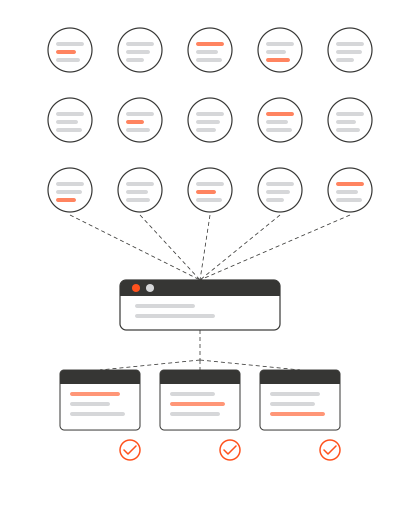
Talc dockets run into the tens of thousands. But the strength of each case still depends on one claimant's specific ovarian cancer diagnosis, one oncological care history, one treatment timeline that either holds up or introduces complications.
SettLiT surfaces that individual picture at scale, structured health intelligence across every claimant in your docket so qualification decisions are grounded in verified data rather than what claimants remember from intake.
Health Data Before Investment
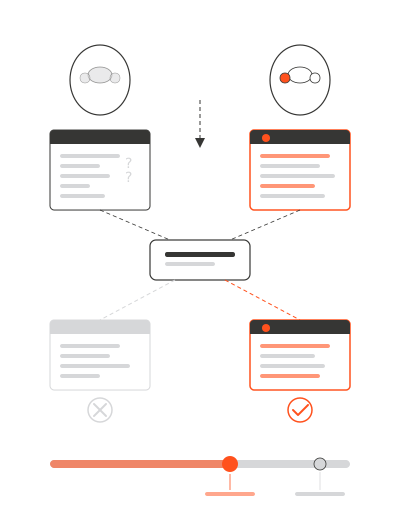
In talc litigation, the cost of committing to a case before understanding the full oncological picture is compounded at docket scale. Firms that begin retrieval and case preparation without first establishing what the medical record contains absorb both the administrative burden and the risk of late-stage discoveries that require strategy to be rebuilt.
SettLiT surfaces structured oncological data early so teams understand what they are working with before resources are deployed. More complete case workups from the start. Less administrative effort during the retrieval phase. Faster movement from qualification to case strategy and resolution.
See What Defense Will See, First
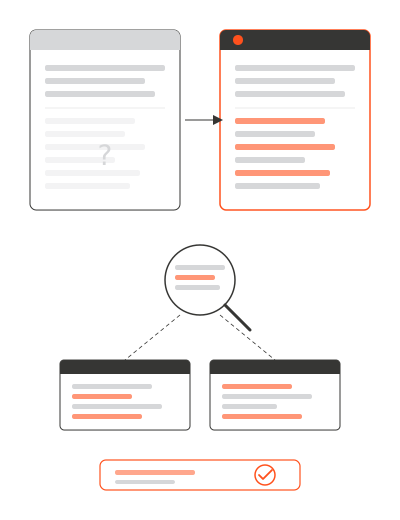
Talc defense teams are well-resourced and have fought through multiple bellwether trials. They will
find prior diagnoses, alternative causation factors, and treatment gaps that weaken your position. The question is whether you find them first.
SettLiT gives your team the same visibility into the claimant's medical history that defense will eventually obtain. Identify complicating factors early. Adjust strategy before you commit resources. Build cases that survive scrutiny from day one.
Why Firms Choose SettLit For Talc Qualification

digital health Data First
Surface ovarian cancer diagnoses, staging, and oncology treatment history before retrieval begins.

Provider discovery
Identify OB-GYNs, gynecologic oncologists, surgical centers, and infusion facilities across the claimant's care history.

structured medical outputs
Receive diagnoses, procedures, and treatment timelines in formats built for talc litigation workflows.

Targeted retrieval enablement
Focus retrieval on the gynecologic oncology providers most likely to produce records that advance the case.
Scalable docket workflows
Process thousands of talc claimants with the same rigor you would apply to one.
Integration Ready Infrastructure
API and portal access. Integrates with Filevine and Smart Advocate.
Testmonials
Results from our
partners experience
“This is so simple, it eliminates the need for faxing, emailing, or mailing requests—everything is handled automatically through the system.”
.svg)
Mass Tort Firm
Attorney
"We recently transitioned to a different AI platform and we have used it for less than a month, but it's not great. So, I think we're trying to explore other options, and this looks incredible."
.svg)
Personal Injury Practice
Paralegal
“48 hours is amazing. We're not used to that at all."
.svg)
Personal Injury Practice
Attorney
"I mean, this is a dream come true... Because it's so hard to get medical records. And now there's this database where you can get them in minutes or days."
.svg)
Personal Injury Firm
Litigator
"Yeah, they are complex. One of the reasons that it's nice to see it all at a glance because this is taking me a lot longer just to get about a quarter of the data. So this is pretty awesome... Yeah, nice to see it in real time, you know, give me information that I just had no idea about."
.svg)
Personal Injury Firm
Attorney
.svg)