Prove the Treatment. Every Network. Every Client.
Surface mental health diagnoses, prescription history, and therapy encounters across your social media addiction docket
Social media addiction litigation is consolidated in MDL 3047 in the Northern District of California, before Judge Yvonne Gonzalez Rogers, and in JCCP 5255 in California state court. Meta, Google (YouTube), TikTok, and Snap face thousands of personal injury claims from young people who allege the platforms were designed to be addictive and caused anxiety, depression, eating disorders, self-harm, and suicidal ideation. In 2026 the tort moved from filings to outcomes: a Los Angeles jury returned the first verdict against Meta and YouTube, Meta agreed to pay up to $17.1 billion to settle with state attorneys general, and all four defendants settled the November bellwether rather than face a jury.
Every claim turns on two things: documented platform use and a documented mental health injury. The first lives on the platforms and the client's devices. The second lives in the medical record, and that is where social media dockets get hard. Claimants are young and many are minors. Their hospital records are thin and their pharmacy history is heavy. Their therapists and behavioral health practices often sit outside the exchanges. Proof of injury, proof of treatment, and the prescriber who connects them each live in a different place.
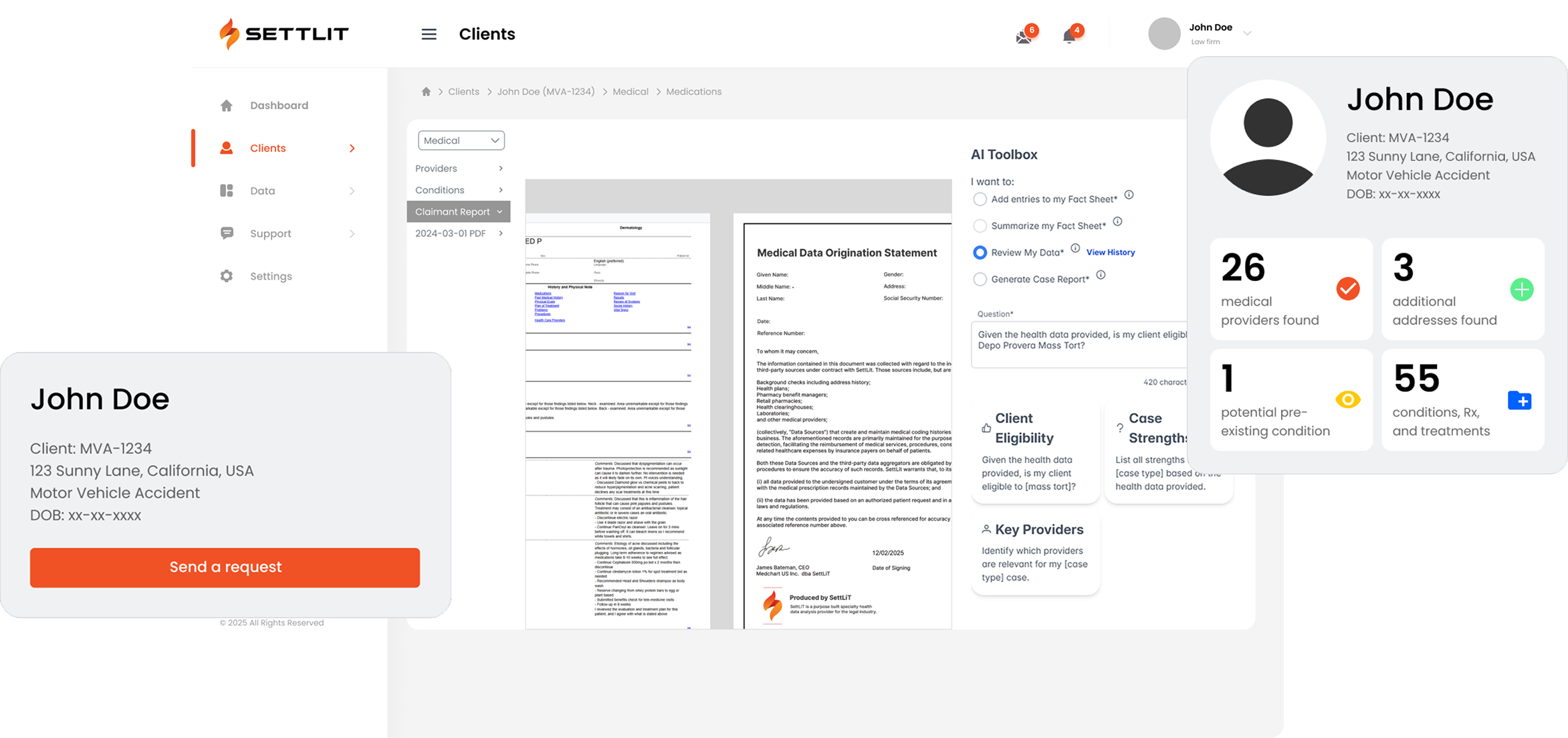
SettLiT provides the digital health data that helps firms qualify social media claimants earlier, confirm diagnoses and treatment through claims and pharmacy data, and build the treating-provider roster before a single records request goes out.
What Makes Social Media Qualification Operationally Demanding
Social media claims require a qualifying mental health diagnosis, documented treatment, and a timeline tied to platform use, often for claimants who are still minors. Hospital records are thin at that age, pharmacy history is heavy, and therapists often sit outside the exchanges. The evidence was never in one chart.

INCOMPLETE INTAKE NARRATIVES
Teenagers and parents rarely know every provider, prescription, or diagnosis. The intake form is a starting point, not a record.

THE TIMELINE PROBLEM
Defense will ask when the anxiety or depression started. Dates of diagnosis, first prescription, and first therapy visit have to line up with platform use.

CAPITAL DEPLOYED TOO EARLY
Firms fund workup on claims whose diagnosis never made it into a record. With thousands of claimants in the pipeline, cases that fall short still absorb the full cost.

LATE LITIGATION SURPRISES
Defense finds a diagnosis that predates the platform, a family history, or an undisclosed provider you never saw. An incomplete mental health record is your biggest exposure.
Prove the Treatment Before You Commit
The firms building stronger social media dockets are not starting with retrieval. They are starting with health data: structured records that confirm the diagnosis, the prescriptions, the therapy visits, and the providers behind them, before a single request is sent. It isn't magic. It's access.
What SettLiT Surfaces in Social Media Cases
SettLiT connects to national health data networks and structured medical datasets to surface the signals that matter in social media cases.
These may include:

Prescription history for SSRIs, SNRIs, antipsychotics, sleep and PTSD medications, with NDC codes, fill dates, and the prescribing clinician

Mental health diagnoses including anxiety, depression, body dysmorphia, eating disorders, suicidal ideation, and self-harm, with ICD-10 codes and dates

Treating providers across child and adolescent psychiatry, psychology, behavioral health, counseling, eating disorder, and addiction medicine

Treatment encounters including psychiatric evaluations, psychotherapy, crisis care, emergency visits, and inpatient or residential programs

Screening scores and secondary diagnoses from the medical record, including PHQ-9, GAD-7, and PCL-5 results, PTSD, insomnia, ADHD, and OCD
Mapping Data to Social Media Eligibility
Social media claims require a documented mental health injury, documented treatment, and a timeline that survives a causation defense. SettLiT maps to all three.

Proof of Treatment
Pharmacy fills for antidepressants and anxiolytics, therapy CPT codes, psychiatric evaluations, and crisis encounters confirm the client was treated, even when the therapist's chart sits in no exchange.

A Timeline That Holds
Dates of diagnosis, first prescription, and first therapy visit, set against the period of platform use, so causation is argued from the record instead of recollection.

Proof of Injury
Claims data from emergency, inpatient, and outpatient encounters carries the diagnosis codes for anxiety, depression, eating disorders, self-harm, and suicidal ideation.
Thousands of Claimants. One Plan.
Social media dockets run in the thousands, and the claimants are young. Running every network on every claimant is a budget decision, not a data decision. SettLiT has a phased network strategy built for this docket: data fees apply only on successful queries, so misses cost nothing, one base fee per claimant covers twelve months of network queries, and any network can be added to any claimant at any time.

Built for Minors
Most of the docket is under 18, and the adult playbook does not fit. Hospital and exchange records are thin at that age. Pharmacy history is not: antidepressants, anxiolytics, and sleep medications are direct evidence of treatment, and the prescriber on every fill points to the treating clinician.
For adult claimants, add Marble Pass: the client verifies their identity from a phone, retrieves their own records including from patient portals, and chooses whether to share them with your firm. Minors are excluded from Marble Pass, and the phased network strategy carries the rest of the docket.

Find It Before Meta, TikTok, Snap, and YouTube Do
Defense will argue the injury predates the platform, runs in the family, or has another cause entirely. The first bellwethers of 2026 ended in a plaintiff verdict and a round of confidential settlements, and the defense knows which claims carry a documented injury and which do not. Pre-existing diagnoses, treatment gaps, and undisclosed providers decide which claims hold.
SettLiT gives your team the same visibility into the claimant's medical history that the defense will eventually obtain. Identify the complications early. Adjust strategy before you commit resources.


Why Firms Choose SettLiT For Social Media Qualification

Digital health data first
Surface mental health diagnoses, prescriptions, and therapy encounters before retrieval begins.

Provider discovery
Identify pediatricians, therapists, psychiatrists, counselors, and emergency providers across the claimant's full care history.

Structured medical outputs
Receive ICD-coded diagnoses, NDC-coded fills, CPT-coded encounters, and treatment timelines in formats built for social media litigation workflows.

Targeted retrieval enablement
Focus retrieval on the behavioral health practices and treating clinicians most likely to produce the chart that advances the case.
Scalable docket workflows
Process thousands of social media claimants with the same rigor you would apply to one, through bulk upload or API.
Integration ready infrastructure
API and portal access. Integrates with Filevine, SmartAdvocate, and Clio.