

Most personal injury firms treat health data as a pre-litigation checklist item. Get the documentation. Review it. Move on.
That approach worked when treatment data came from two or three local providers and arrived in a manila envelope within a few weeks. It doesn't work when your client has seen 15 providers across three states and your opponent has queried their entire claims history before you've sent your first authorization.
The firms that consistently outperform on case outcomes aren't doing more of the same. They're doing smarter data strategy, and they're doing it earlier.
The Timing Problem in Health Data Collection
Traditional workflows operate on a reactive timeline. A case comes in. Intake collects the basics. A paralegal sends authorization letters. Documentation trickles in over 30 to 60 days, creating a medical records bottleneck that affects every downstream decision. The attorney reviews it when it arrives.
This workflow creates two problems.
First, it delays case evaluation. You can't value a case accurately until you understand the medical picture. But if that picture takes months to assemble, you're making strategic decisions in the dark. Which cases get priority? Which cases merit early settlement discussions? Which cases need expert retention? These decisions happen before the picture is complete.
Second, it hands the defense an information advantage. Insurance carriers don't wait for documentation to arrive in the mail. They query claims databases. They know about pre-existing conditions, prior treatment patterns, and potential inconsistencies before you do. By the time your records arrive, opposing counsel has already built their narrative.
The solution isn't faster retrieval. It's earlier visibility.
What Early Health Data Access Looks Like
Early visibility means knowing the shape of your client's medical history within days of intake, not weeks.
This doesn't require full clinical records from every provider. It requires structured data from the systems that aggregate care across providers: claims clearinghouses, pharmacy benefit managers, lab networks, and state health information exchanges. Understanding how law firms access medical records today helps explain why these digital sources matter.
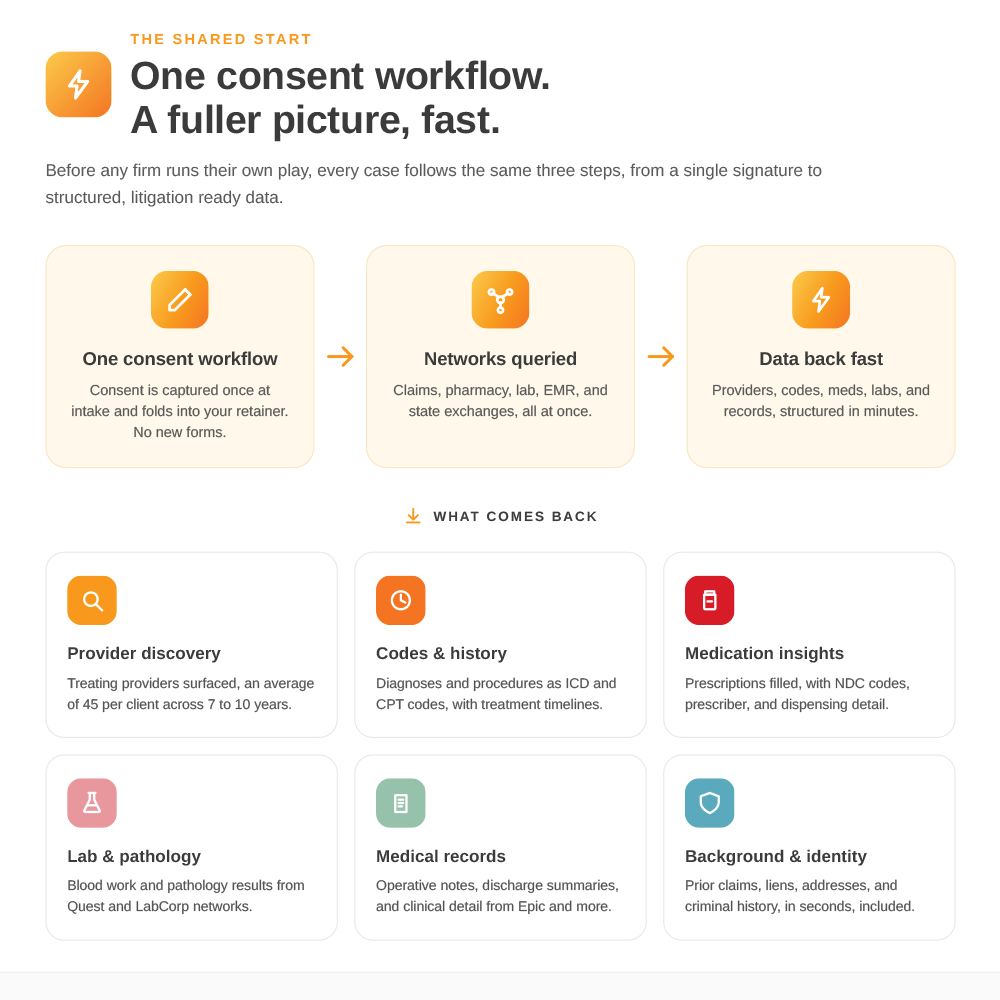
With a single patient authorization, you can query these networks and return:
A complete provider list. Not the providers your client remembers, the providers who actually treated them. Claims data captures every billed encounter, including specialists seen once, urgent care visits, and out-of-network providers.
Diagnosis codes over time. ICD codes tell you what conditions were documented, when they were documented, and by whom. You can see pre-existing conditions, accident-related diagnoses, and treatment progression without waiting for chart notes.
Medication history. Pharmacy data provides an objective timeline of treatment. Fill dates, refill patterns, and dosage changes all tell a story. Without pharmacy records, you're left with provider notes that may or may not reflect actual patient behavior.
The Defense Already Has a Complete Picture
Here's the uncomfortable truth: defense counsel often has better access to your client's medical history than you do.
Insurance carriers maintain claims databases that track every diagnosis code, every procedure code, and every provider encounter associated with a claimant. When a claim is filed, that data is queried. Pre-existing conditions are flagged. Treatment patterns are analyzed. Potential inconsistencies are identified.
This information asymmetry is baked into the system. Plaintiffs' attorneys request records one provider at a time, waiting 30 to 60 days for each response. Defense counsel queries a database and sees the full claims history in days.
The gap isn't about legal strategy. It's about information infrastructure.
Why Client-Provided Provider Lists Fall Short
Understanding where medical records go missing helps explain why traditional retrieval methods consistently underperform.
Client memory is incomplete. Clients don't remember every provider. They conflate practice names. They forget specialists they saw once. Relying solely on client-provided information guarantees gaps. Getting the right data at the right time means closing these gaps before they become problems.
Provider lists miss transitions. When a client switches insurance, changes jobs, or moves, their medical care follows. But their memory of that care doesn't always keep pace. Records from previous coverage periods are rarely requested unless the attorney already knows to ask.
Authorization turnaround creates bottlenecks. Even when you know which records to request, the retrieval process takes weeks. Providers have 30 to 45 days to respond under most state regulations. Multiply that by 10 or 15 providers and you're looking at months before the picture is complete.
Pharmacy and lab data are afterthoughts. Many firms focus on provider records and overlook pharmacy benefit managers, lab networks, and diagnostic imaging centers. These data sources often contain the most objective evidence of treatment and diagnosis.
How to Implement Early Health Data Access
Improving record completeness doesn't require abandoning traditional retrieval. It requires supplementing it with better visibility earlier in the case lifecycle.
Start with a provider discovery process, not a provider list. Rather than asking clients to list their providers, ask about their care timeline. When did you first notice symptoms? Where did you go first? Were you referred anywhere? Who prescribed your medications? This narrative approach surfaces providers that a simple list would miss.
Query claims and pharmacy data early. Claims clearinghouses and pharmacy benefit managers maintain longitudinal records that span providers and insurance plans. Running these queries at intake, before ordering full records, gives you a map of where to focus retrieval efforts.
The firms that adopt this approach make better case selection decisions from day one. They build stronger cases because they understand the full medical picture from the start. For mass tort qualification, this prioritization becomes even more critical at scale.
The Information Gap Is Your Real Competition
Personal injury practice is competitive. Firms compete for clients, for attention, and for results. But the most important competition happens in the case itself: the competition for information.
The side with better information wins. Not always, but reliably. Better information means better case selection. Better information means better negotiation leverage. Better information means fewer surprises at deposition and trial.
Defense counsel has had information infrastructure advantages for years. Claims databases, medical canvasses, surveillance technology. Plaintiffs' firms have relied on client memory and manual processes.
That gap is closing. The firms that close it first will have an advantage. The firms that wait will continue to operate at an information disadvantage they may not even recognize.
Health data strategy isn't a back-office function. It's a competitive lever. The question is whether you're pulling it. Watch our webinar to see how this works in practice.
.svg)

.png)