
Behind every plaintiff fact sheet is a person who got hurt and is waiting to be made whole. They filled a prescription that wasn't supposed to harm them, or they lived next to the wrong facility, or they were handed a product that carried a risk nobody disclosed. The fact sheet is how the court learns their story is real. And as the paralegal completing it, you're the one who turns that story into something the record will accept.
That's a heavier job than it looks, because a plaintiff fact sheet doesn't run on the story. It runs on the facts. Dates of diagnosis. Diagnosis codes. The drug, by name and by NDC. The providers who treated the condition. The exposure window. A fact sheet built on a client's best recollection can feel complete right up until a deficiency notice arrives, and then the work starts over against a shorter clock, with the case itself at risk.
Where fact sheets break down
The breakdown is almost never carelessness. It's that the facts live in places the client simply can't reach from memory. A claimant in a pharmaceutical mass tort might remember "a pill for my back" but not the NDC code, the fill dates, or the prescribing physician's name. A toxic-exposure claimant might know they were sick but not the exact diagnosis code the defense will check the fact sheet against. You can chase each of these provider by provider, with authorizations and follow-up calls and a four-to-six-week wait per request, but in a docket of hundreds or thousands of claimants, that math doesn't work. The deadline arrives before the facts do.
Fact sheets go in with blanks, or with the client's approximation, and the defense reads them for exactly that: a wrong diagnosis, a drug the records don't confirm, a date that doesn't line up. Each one is a cure notice, a delay, and in the worst case the dismissal of a legitimately injured person's claim.
Filling the fact sheet with verified data, not recall
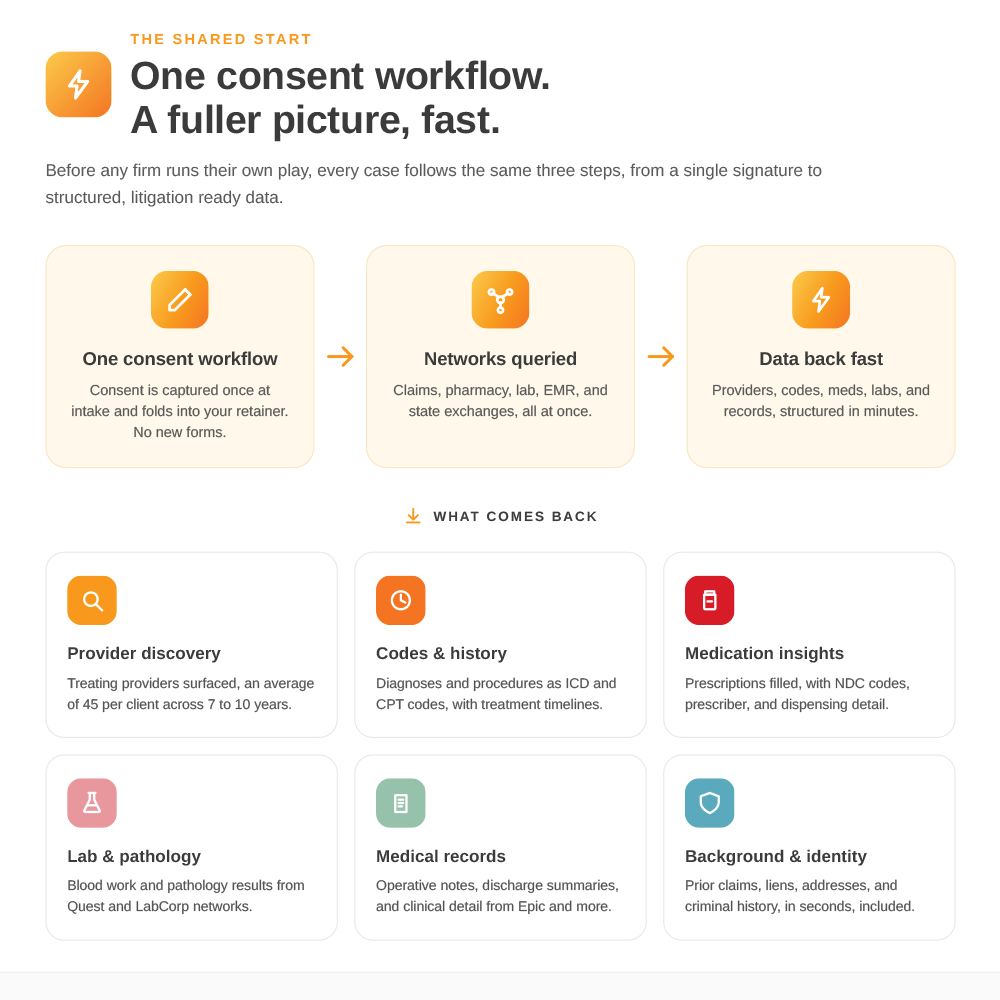
This is the gap digital health data is built to close. With a single patient authorization, a query runs against national digital networks and returns the structured facts a fact sheet actually asks for, in minutes rather than weeks.
For pharmaceutical torts, pharmacy network data returns prescription history with NDC codes, fill dates, and the prescribing physician at close to a 100 percent hit rate for insured claimants. That's the difference between "a pill for my back" and a documented dispensing record you can put in the field. For injury and exposure torts, claims clearinghouse data returns diagnosis and procedure codes tied to dates of service at an 85 to 90 percent hit rate, so the diagnosis on the fact sheet matches the diagnosis in the record. Reference lab data covers over 80 percent of U.S. outpatient lab volume, which matters when the qualifying proof is a pathology result or an exposure level. And the provider list, which averages around 45 providers per claimant, tells you everyone who treated the person, including the ones they forgot to mention.
The point isn't speed for its own sake. It's that you can complete the medical sections of a fact sheet from verified data instead of from a phone call, and you can do it at the scale a mass tort actually demands. One firm worked through 6,000 Roundup claimants this way for a filing deadline. Another ran 8,000 AFFF claimants, with lab data doing the heavy lifting on exposure confirmation. Batches of that size are routine, not exceptional.
What it won't do
It's worth being realistic with your team about the edges. This is digital-first, not digital-only. When claims and pharmacy data are combined, you'll see useful history for roughly 60 percent of claimants, which means some providers, particularly small private practices and anyone not yet connected to digital networks, won't surface. The data returned is structured records and clinical documents, not the certified narrative chart you may still need to order for certain fields. It complements traditional retrieval rather than replacing it: digital data fills most of the fact sheet quickly and tells you exactly where to send the few targeted requests that remain, turning a scramble of 10 to 20 requests into 2 or 3 that matter. For mass tort work, the same data can also support a proof-of-injury report with a signed certification, the kind already used in AFFF, PFAS, and opioid litigation.
The bottom line
A plaintiff fact sheet is a promise to the court that the injury is real and the facts are straight. When it goes in on guesswork, you spend the next month defending blanks instead of moving the case, and a real person waits longer for what they're owed. When it goes in on verified data, it holds.
The next time a fact sheet stalls on a blank the client can't fill, it's worth seeing how much of it the digital record can answer before the deadline does.
.svg)

.png)