

The firms cleaning up the best cases aren't doing it by accident. They're running on data the rest of the industry hasn't figured out how to get yet.
Over the past year, members of our team have sat through a version of the same conversation at nearly every legal industry conference they’ve attended. Different cities, different bars, different attorneys. The topic, every time, is the same: how is it that certain firms always seem to land the strongest cases, leaving everyone else to fight over what’s left?
The theories run from creative to conspiratorial. Inside relationships at hospitals. Backroom marketing deals. Illegal access to patient files. By one attorney’s read, almost certainly breaking the law. Same accusations, different cities, every time.
None of those theories are correct.
The actual answer is more disappointing if you were hoping for a scandal, and more useful if you’re running a firm. The firms in question have rebuilt their intake process to run every potential client through a full medical history before deciding to invest in the case. They modernized their workflow around a data source most firms do not know exists. And they keep quiet about it, because for as long as the rest of the industry does not catch on, they hold the advantage.
Every case is a puzzle. Most firms are missing pieces they don't know are missing.
Every personal injury and mass tort case turns on medical information. The firm has to know what happened to the plaintiff, when, where, and by whose hand, in order to take the case, qualify it, build the demand, cure deficiencies, and stand up to cross-examination.
Today, most firms build that picture from two sources. Client memory, captured at intake. And documents pulled from providers the client managed to name. Both are incomplete by nature. Clients forget half the providers they have seen. Self-reported history rarely matches the chart. The pieces that are not named are the pieces that show up later, on a defense exhibit, in a deposition surprise, or in a deficiency notice the firm cannot cure in time.
There is a third source. Patient-authorized health data, drawn from the digital networks where 85 percent of United States health information already lives. Claims clearinghouses. Pharmacy networks. State health information exchanges. Major electronic health record systems. This data has been digital for more than a decade. The defense bar has been using it through insurance and claims relationships for years. A small number of plaintiff firms have figured out how to access it. The rest of the industry has not.
"You don't know what you don't know. You never knew you were missing it. But once you have it, you can never go back."
What changes when the picture is complete
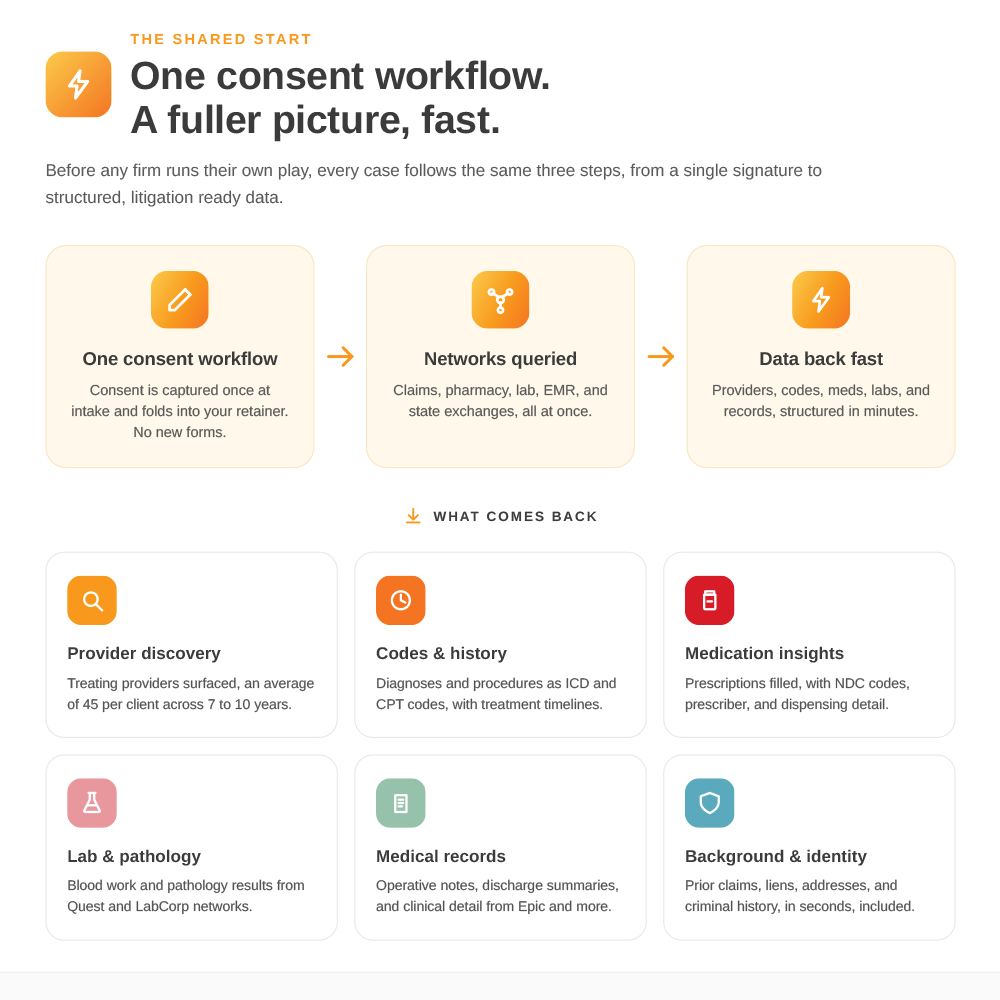
In demos, the pattern repeats with almost every firm. Intake captures eight providers the client remembers. The query returns thirty or more the client did not mention. Pharmacy data shows up. Diagnoses no one disclosed surface. A treatment gap that did not fit the timeline suddenly makes sense, or doesn't, and the case looks completely different than it did at sign-up.
In a single personal injury matter, that picture changes what happens at every decision point. At intake, the firm takes or declines on what is in the chart, not on what the client remembered. Pre-existing conditions and undisclosed treatment are visible before the retainer is signed. At discovery, the provider list is not what the client recalled, it is what objectively happened. At demand, damages are built on the complete record. At trial prep, the firm walks in with the same medical picture the defense already has.
In a mass tort, the same data is the difference between protecting an inventory and watching it shrink. Plaintiffs get qualified against MDL criteria the moment they sign, before the firm carries six months of cost on a plaintiff who cannot survive a fact sheet. Plaintiff fact sheets are auto-populated with source-verified data, so deficiencies drop. When the defense files a deficiency on 800 plaintiffs in the inventory, the cures run through in days, not quarters. Bellwether candidates are picked on the strength of the underlying medical record, not the strength of the intake notes. Settlement matrix tiers are backed by audit-ready medical proof. Liens are identified before they ambush net recovery.
Same product, both contexts. The decisions are different. The data is the same.
The shift the leading firms have already made
It is worth being precise about what changes when a firm adopts this kind of data, because the surface-level value and the structural value are not the same thing.
The surface value is real but incremental. Drop the data into the existing workflow and decisions get sharper. Demand letters get more accurate. Depositions hold fewer surprises. Bad cases get caught earlier. This is the better, faster, cheaper version of what firms already do.
The structural value is different. The firms that are pulling away from the pack have not just added a data source. They have redesigned their back office around it. Intake is no longer a paperwork exercise. It is a qualification step. Pre-litigation evaluation is no longer a waiting game. It is a triage step. Pre-deposition preparation is no longer a discovery process. It is a verification step. Plaintiff inventory management is no longer a quarterly damage-control exercise. It is a continuous operations function.
Every intersection point in the case lifecycle, from first contact through settlement, looks different when the firm is operating with the complete picture from day one. The work that used to take three years can move in a fraction of that time, because the picture was clear at the start instead of at the end.
Why nobody is going to tell you about this
There is a structural reason the firm down the street has not called to share. There is a structural reason this is not getting talked about more broadly either.
The legal industry has been organized around documents for a very long time. The standard workflow is built on requesting paper records from providers a firm already knows about, and traditional record retrieval is still required for many parts of a case. Certified records for trial. Narrative notes from private practices. Providers that are not yet in any digital network. None of that is going away.
What is also true is that the digital networks described in this piece sit outside the document-and-paper model entirely. They require organizational trust, network agreements, compliance certifications, and use-case approvals that take years to negotiate. Most of the legal industry has not had a way in. And telling a customer that an entire layer of information exists outside their reach is not a conversation most service providers are positioned to start.
The firms that have figured this out are not in a hurry to share either. Their contracts often prohibit public reference. Their leadership treats this as a competitive advantage. They understand, correctly, that the moment the rest of the industry catches up, the advantage compresses. Their incentive is to stay quiet.
The honest version
In those conversations at the bar, the people speculating were closer to the truth than they realized. They were right that something was different. They were wrong about what it was. The firms in question were not breaking the law. They were reading the law correctly, which says that patient-authorized health data is available to attorneys representing those patients, and they were acting on that earlier than anyone else.
There is no hidden marketing channel. There is no backroom deal. There is a data layer, sitting in digital networks that have been operational for over a decade, accessible through compliant pathways, and the firms that figured out how to use it first are not telling anyone.
SettLiT is a digital health data platform for personal injury and mass tort law firms. Through patient-authorized access to national digital networks, including claims clearinghouses, pharmacy networks, lab systems, state health information exchanges, and electronic health record systems, SettLiT returns a fuller picture of client medical history in minutes, not months.
Book a demo to see what most plaintiff firms have been missing.
.svg)

.png)