
There is a sequence so deeply embedded in personal injury practice that most attorneys have never thought to question it. Before you build a medical chronology, you get the records. Before you send a demand package, you get the records. Before you can do almost anything substantive on a case, you wait, sometimes days, sometimes weeks, for the records.
This white paper makes a simple argument: that sequence was built for the courtroom, most cases never reach one, and the delay it creates is quietly costing firms settlement value on every case.
Prefer to read offline, or share it with your team? Download the full white paper as a PDF.
The workflow attorneys inherited
This sequence has a history, and for most of that history it made sense. Personal injury law was built in the courtroom. The procedural frameworks attorneys trained on, including evidence rules, foundation requirements, and chain of custody, were designed for a world where every dispute ended in front of a judge and jury. In that world, the integrity of the medical record is not a bureaucratic formality. It is the difference between admissible evidence and a sustained objection. The custodian affidavit, the certification from the health information management department, and the documented chain from treating provider to court exhibit are not inefficiencies. They are requirements.
The problem is that the practice of law changed faster than the workflow did.
Settlement became the dominant outcome in personal injury cases, not occasionally, not as a fallback, but as the primary and expected resolution. The demand package replaced the trial brief as the primary work product driving case value. And yet the workflow stayed exactly where it was, built for a world that now describes a small minority of cases.
The result is a workflow with a courthouse assumption baked into its foundation, applied universally to a practice that only occasionally ends up in a courthouse.
What adjusters actually do with your demand (and what happens while you wait)
When a demand package lands on an insurance adjuster's desk, they are not performing evidentiary review. They are doing math.
The adjuster's job is to evaluate exposure, to answer, as accurately as possible, what this claim is likely to cost the carrier if it goes unresolved. To do that, they are looking at the treatment arc: what happened to this person, in what sequence, over what period of time. They want to understand the nature and severity of the injury, whether the treatment course is consistent with that injury, and what the documented outcome looks like.
What they are not doing is asking whether the records behind that picture would survive a hearsay objection. Admissibility is a trial concept. The adjuster is not evaluating evidence for presentation to a factfinder. They are evaluating a claim for settlement. The 803(6) business records exception, the custodian certification, and the foundation requirements that make a medical record court-ready are not part of the adjuster's calculus.
The second half of the problem is more expensive.
Every week that passes between a plaintiff's last treatment date and the moment the adjuster reviews your demand package is a week working against your client's settlement value. A long gap between last treatment and demand delivery implies, in the adjuster's mental model, that the injury was not serious enough to sustain ongoing medical attention, that the plaintiff may have recovered more fully than the demand represents. The injury looks less acute. The claim looks less compelling. The opening offer reflects that.
For a firm operating on contingency, demand timing is not a workflow variable. It is a revenue variable. A demand package delivered 14 days faster, consistently, across an entire docket, does not just close cases more efficiently. It preserves settlement ceiling on every one of those cases.
The records workflow was never designed with any of this in mind. It was designed to produce admissible exhibits. In doing so, it introduced a delay that, for the vast majority of cases that never reach trial, carries no evidentiary benefit. It only adds cost.
Where health data drives value (and where records still matter)
Nothing in this argument suggests that certified, admissible medical records do not matter. They do. The mistake is not in the standard. It is in when and how that standard is applied.
Personal injury workflows were built around producing admissible records. But most cases are resolved based on something else entirely: an understanding of the health data behind the injury. Before a case ever reaches litigation, value is determined in the demand phase. And at that stage, what matters is not whether a record can survive a hearsay objection. What matters is whether you can clearly answer: what treatment occurred, in what sequence, over what duration, with what outcome.
That is not a records problem. That is a health data problem.
Pre-litigation: where speed and clarity win
In pre-litigation, timing and narrative control are everything. The attorney who can quickly reconstruct the treatment story, while it is still current and the gap between treatment and demand is minimal, has a structural advantage. They are not waiting to understand their case. They already do. That shows up in faster demand delivery, stronger and more coherent narratives, less erosion of perceived injury severity, and better opening positions in negotiation.
This is where health data becomes a competitive advantage. Not because it replaces records, but because it allows you to act before records are fully assembled and certified.
Litigation: where preparation still wins
But the case does not always end there, and this is where many workflows create risk. If the only time a case becomes fully understood is after certified records arrive, then the firm is always reacting, never ahead. A workflow built on early access to health data does something different: it ensures you are never caught flat-footed. By the time litigation is on the table, you already understand the treatment trajectory, the consistency or inconsistency of care, the key inflection points in the medical story, and the strengths and vulnerabilities of the case.
The certified records don't create that understanding. They validate and formalize it.
The right separation
This reframes the role of each component in the workflow. Health data is for understanding and decision-making, immediately. Certified records are for admissibility and litigation, required, but not gating. Both are necessary. But they serve different purposes, at different stages.
The real question
The traditional workflow assumes that understanding the case must wait for the record. But if the goal is to maximize value in pre-litigation and avoid being exposed in litigation, then the question is not whether records matter. It is: why should understanding your case depend on when they arrive?
A different workflow (and a question worth asking)
The alternative workflow is not radical. It is simply reordered. Instead of treating certified records as a prerequisite for all downstream work, the process separates access to medical data from the documentation required to make that data admissible.
The sequence becomes:
- Access the underlying medical data. Treatment history, provider notes, and diagnostics, retrieved as quickly as possible, including directly from EHR systems where available.
- Build the chronology and send the demand, while the treatment narrative is still current and the case retains urgency.
- Initiate the full certified records request in parallel, allowing the documentation required for litigation to develop in the background, without delaying the negotiation process.
Nothing is removed from the workflow. The same records are obtained. The same standards are met. The difference is that the demand no longer waits for the certification.
For high-volume PI practices, the impact is immediate. Cases move into the adjuster's queue weeks earlier. The gap between treatment and demand narrows. Settlement timing improves. And the value that would otherwise erode during that delay is preserved.
The workflow attorneys inherited was built for the courtroom. It was designed to satisfy evidentiary requirements in a world where every case was expected to reach trial. That world still exists, but it describes a small fraction of the cases most firms handle.
So the question is not whether the traditional workflow is correct. It is whether it belongs everywhere it has been applied without examination. For the demand stage, for carrier negotiation, for the vast majority of cases that will never require a certified exhibit, does it?
Where SettLiT fits
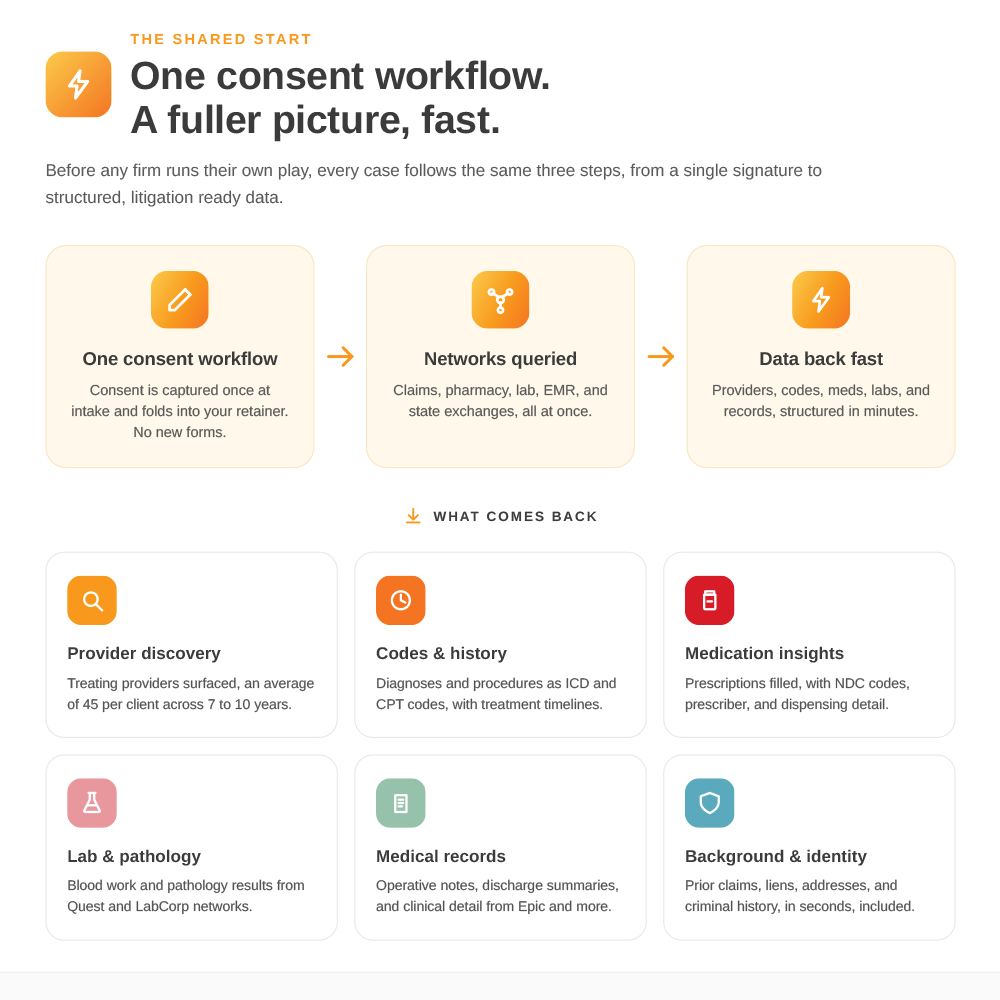
SettLiT gives personal injury firms patient-authorized access to the digital health data behind a case, provider history, diagnoses, medications, and treatment timelines, in minutes. That is what makes the reordered workflow possible: you can build the chronology and send the demand while the case is still current, then let the certified records develop in parallel. It is digital-first, not digital-only, and it does not replace your retrieval process. It isn't magic. It's access.
See how it works, or book a demo. And if you want the full argument in one place to share with your team, download the white paper as a PDF.
.svg)