

Every plaintiff attorney who has sent a policy limits demand knows the quiet risk inside it. You're telling the carrier their insured's exposure runs to the top of the policy, and you're giving them a window to pay before that exposure becomes their problem instead of their insured's. Get it right and you set up a clean tender, or a bad-faith claim if they refuse. Send it thin, and the adjuster files your letter next to every other demand they decline without a second thought.
The difference between those two outcomes usually isn't the number. It's the evidence behind the number. A demand that asserts catastrophic injury reads very differently from one that documents it: every treating provider accounted for, a diagnosis history that holds together, a causation timeline with no unexplained gaps. The carrier's job is to find the soft spot. Your job is to make sure there isn't one before the letter goes out. That's a documentation problem, and it's the one most demands lose on.
What carriers actually do with your demand
When a policy limits demand lands, the adjuster doesn't ask "is this person hurt." They ask "what can I use to discount this." And they're not guessing. The defense side has been working from digital health data through claims relationships for years, scanning for the same three things every time: a pre-existing condition they can attribute the injury to, a treatment gap they can argue means recovery, and a provider you didn't disclose who tells a different story.
If any of the above exist and you don't know about them, the carrier likely does. They can sit on your demand, let it expire, and surface the problem later, when it costs you leverage instead of them. The defense already has the printout. A demand built only on the records your client remembered to mention is a demand built while the carrier holds cards you haven't seen.
Evidence that closes the gaps, not dollars
It's worth being precise about scope here, because overclaiming on a demand gets you burned. A digital health data pull doesn't generate your damages number, and it doesn't return billed dollar amounts. What it returns is the medical evidence underneath the number: the structured, source-backed picture that makes the number defensible.
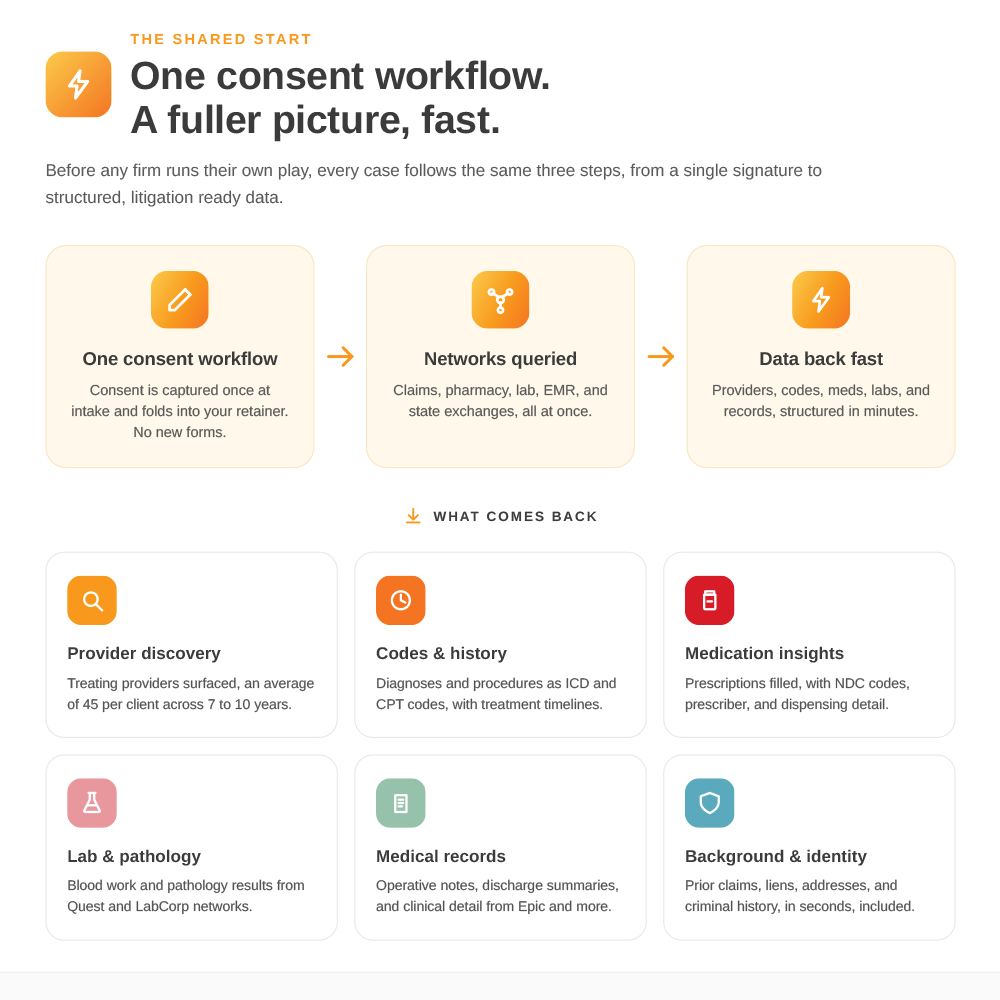
Run your client through national digital networks and you get the things a demand lives or dies on. The full provider list, typically around 45 providers with specialties and dates, including the ones your client forgot. Diagnosis and procedure codes from claims clearinghouse data at an 85 to 90 percent hit rate, tied to dates of service, so the injury you're claiming is the injury the record shows. Medication history from pharmacy networks at close to 100 percent for insured clients, so pre-accident treatment is something you address on your terms instead of something the adjuster springs later. And where lab or pathology results matter, our data access covers roughly 80 percent of U.S. outpatient volume.
That's what hardens a policy limits demand. Not a bigger assertion, a tighter one. Every provider accounted for. The causation timeline complete. The pre-existing question answered in your framing, with documentation, before the carrier gets to ask it.
Turning the data into the demand
Having the data is the first step; presenting it is the second. A demand reads as credible when the evidence is organized the way an adjuster, and later a judge, would want to check it. In practice that means a clean treatment chronology built from the dates of service, a provider roster that shows the full arc of care rather than a curated handful, and a clear line connecting the accident to the diagnosis codes that follow it. When a pre-existing condition does appear in the record, addressing it head-on, with the dates that distinguish old from new, is far stronger than hoping it stays buried. It also helps to surface the providers your client never mentioned and fold them into the chronology before the carrier can present them as a gap. An adjuster who can independently confirm every date and diagnosis you cite has far less room to argue the file is incomplete, and far more reason to treat the demand as the real measure of exposure. The goal is a demand the carrier can verify and still cannot discount.
Why this is the engine of excess and bad-faith exposure
Consider how a clean tender actually happens. (The following is a composite, illustrative scenario.) Your client was in a serious collision. The story is consistent, the injuries are real, and the medical picture is exactly what it should be: a documented diagnosis, a continuous course of treatment, no competing prior injury to the same region, every treating provider in the file. You send a demand the carrier cannot poke a hole in, because there are no holes. Now the carrier has a decision. Pay the limits, or refuse a fully documented demand and carry the excess verdict and the bad-faith claim that can follow.
That decision only exists because the evidence is airtight. A carrier can decline a thin demand all day and feel fine about it, because they can point to the gap and call the demand speculative. They cannot do that with a demand where the medical record is complete and the causation is clean. Structured medical data is what moves the conversation from "we think it's worth the limits" to "here is why it is." The completeness is the leverage.
It also runs on the right clock. Policy limits demands often carry tight deadlines, and traditional ordering doesn't respect deadlines. You request, you wait four to six weeks per provider, and the window closes before the records arrive. Most digital sources come back in about five minutes, with the full range running five minutes to five days. You can build the documented demand inside the window you actually have, instead of sending a thinner one because the records weren't back yet.
What it won't do, and why that protects you
Be precise about the limits, on a demand more than anywhere. This is digital-first, not digital-only. When you combine claims and pharmacy data, you'll see useful history for roughly 60 percent of clients, so some providers, especially small private practices and anyone not yet in digital networks, won't surface. The data returned is structured records and clinical documents, not the certified narrative chart you'll attach as your evidentiary exhibit, and it does not include billed dollar amounts, so your damages figure still comes from your bills and your experts. It complements traditional retrieval rather than replacing it: the digital pull tells you exactly which providers matter, and you send 2 or 3 targeted requests for the certified records instead of 10 to 20 on guesswork.
Used that way, the limits are a feature. You're not hoping the record is complete. You've checked, you know where the gaps are, and you've closed them on purpose before the carrier could use them.
The bottom line
A policy limits demand rarely fails because the number was too high. It fails because the carrier found something you missed and used it to justify the refusal. Close the gaps first. Document every provider, lock the causation timeline, and answer the pre-existing question before it's asked.
Before the next demand goes out, it's worth knowing what the carrier already sees, so the gaps are closed on your terms rather than discovered on theirs.
.svg)

.png)