

You know the rhythm with adult clients. One signature on the authorization at intake, and the requests go out. It's muscle memory.
Then a minor client lands on your desk, and the muscle memory works against you. The client can't legally sign for themselves. The person signing for them isn't always who you'd expect. And a handful of record categories don't follow the normal rules at all. Get any of it wrong and the request bounces, weeks pass, and the case sits while you chase a corrected authorization.
None of this is hard once you know where the traps are. Here's how consent actually works when your client is under 18, and how to get it right the first time.
Who signs for a minor
Under HIPAA, a minor's medical records are released through their personal representative, which usually means a parent or legal guardian. That person signs the authorization on the child's behalf, the same way they consented to the child's treatment. That's the ordinary rule, and it comes with exceptions: care the minor lawfully consented to on their own, care directed by a court or by someone a court appoints, and situations involving abuse or endangerment concerns, where a provider may decline to treat the parent as the representative at all.
Simple in theory. In practice, the signature is only as good as the authority behind it, and that's worth thinking about at intake rather than after a rejection letter.
A biological parent isn't automatically the personal representative. Custody orders, guardianship arrangements, and foster placements can all shift who holds that authority. If a grandparent, relative, or agency holds guardianship, expect to provide the guardianship order or other documentation appropriate to the claimed role before anything is released.
For an ordinary parent request, the norm is lighter than most teams assume. What's expected is a signed authorization that includes an attestation of the signer's authority, reasonable verification of who the adult signer is, and consistency with what's already in the intake file. Documentary proof, like a custody order, belongs in the picture when something doesn't line up: a name or address mismatch, a known custody dispute, or a signer claiming authority as something other than a parent. HIPAA expects verification that's reasonable and proportionate to the situation, not a birth certificate in every file. In fact, a birth certificate is weaker evidence than it feels: it can help establish parentage, but it says nothing about current custody or who holds health care decision-making authority today.
It's a small habit that saves real time: when the client is a minor, the intake checklist grows by one line. Who holds the authority, and how do we know.
When the parent's authority ends
The age of majority is 18 almost everywhere in the U.S., though not quite everywhere, and the moment your client reaches it, the parent's power to authorize ends with it.
This matters more in injury work than almost anywhere else, because statutes of limitation for minors often toll until adulthood. A case involving a 15-year-old may still be active when that client turns 18. From that day forward, authorizations signed by mom or dad are no longer valid, and your client needs to sign fresh ones themselves. Calendar the birthday like a deadline, because functionally it is one.
Emancipation works the same way, just earlier. A minor emancipated through court order, marriage, or military service, depending on the state, signs for themselves. A parent's signature on an emancipated minor's authorization is worth nothing.
The exception that catches experienced teams
Here's the part that surprises even records veterans: for certain categories of care, the minor consented to their own treatment, and the parent may have no right to those records at all.
Most states allow minors to consent to some or all of the following without parental involvement: mental health counseling, substance use treatment, reproductive and sexual health care, STI testing, and HIV-related care. Some states extend similar protection to genetic information. When a minor lawfully consents to their own care, the minor, not the parent, generally controls the release of those records. Some states are explicit about the mechanics; in California, for example, the minor executes the authorization for care they could lawfully consent to themselves.
Substance use treatment adds a federal layer on top. Records from federally assisted substance use disorder programs carry their own confidentiality protections under 42 C.F.R. Part 2. Where state law allowed the minor to consent to that treatment alone, only the minor can consent to releasing those records. Where parental consent was required for the treatment itself, both the minor and the parent generally sign.
For an injury case, all of this cuts in two directions. Sensitive records your case needs may require the minor's own authorization, on top of the parent's. And records you receive may arrive with those categories segmented out, which isn't a processing error. It's the record holder following the law.
One more wrinkle: which state's rules apply isn't always obvious. It can turn on where the minor lives, where the treatment happened, and the obligations governing whoever holds the records. So treat this whole area as a flag for review rather than a formula. When a minor client's history touches any of these categories, get the applicable rules in front of the supervising attorney before the request goes out, not after the response comes back thin.
Deceased minors and estate cases
In wrongful death and infant injury litigation, including NEC cases, the authorization runs through the estate. Estate documentation, letters of administration, or an affidavit of next of kin is typically what providers and data networks need to see before they'll release anything. A birth certificate can support the file by establishing parentage, but on its own it doesn't establish legal authority, so don't expect it to carry the request.
These cases carry enough weight for the families already. Building the document collection into intake, rather than discovering the gap at the first rejection, is one way the records team quietly protects both the case and the family from another round of paperwork at the worst time. For firms screening mass tort dockets, this documentation step is worth building into the tort-specific checklist itself.
The two clocks
Minor cases run on two clocks, and they move in opposite directions.
The legal clock is generous. Tolling means a childhood injury case may not be filed until years after the treatment happened.
The data clock is not. Lab networks typically retain results for 7 to 10 years, and other digital sources have their own horizons. Records that exist today may be purged by the time your client turns 18 and the case gets moving. If a minor's case is on your docket, the safest move is to capture the medical picture early, while it still exists. You're not just collecting records. You're preserving evidence that won't wait for the statute.
Where digital health data fits
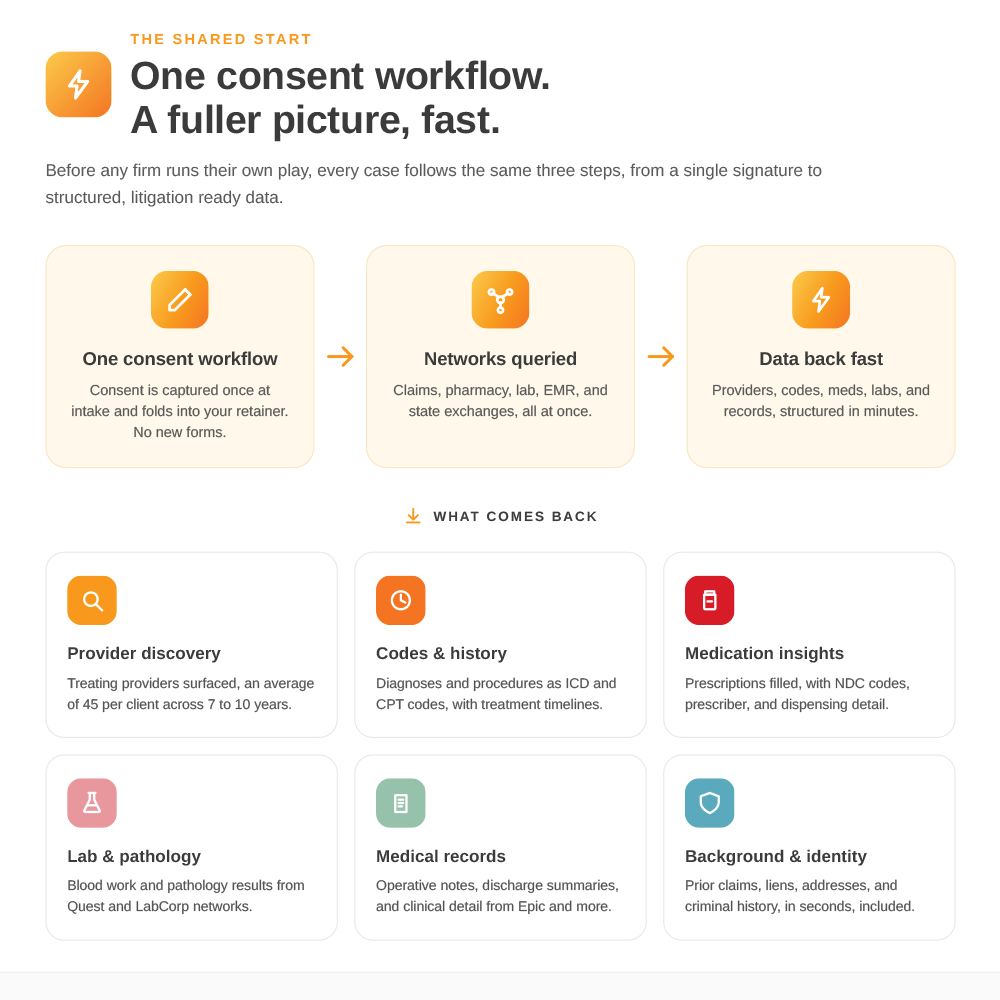
Everything above applies whether you're requesting records by mail or querying national digital networks. A platform like SettLiT runs on the same principle a provider does: no signature, no data. For a minor claimant, that means the patient data agreement is signed by the parent, guardian, or estate representative, paired with an attestation of that authority and verification proportionate to the risk: light for a routine parent request, documentary for guardians, estates, and anything that doesn't line up.
One honest note, because you deserve to hear it plainly: digital network coverage for minors is thinner than it is for adults. Minors face access restrictions across parts of the digital health ecosystem, and infant cases in particular tend to return limited digital data. Where the data does exist, pharmacy fills, claims history, and lab results can anchor a minor's treatment timeline quickly and show you exactly which providers are worth a full manual request. Digital-first, not digital-only: for minors especially, the digital picture complements your traditional requests rather than replacing them.
Getting a minor's records will always take more care than getting an adult's. But the consent piece doesn't have to be the part that slows you down. Confirm who holds the authority, verify in proportion to the risk, watch the birthday, flag the sensitive categories, and start early. The rest is the work you already know how to do.
This article is for general information only and is not legal advice. Consent and release rules for minors vary by state; confirm the requirements in your jurisdiction.
.svg)

.png)