
Picture the client who calls your firm this week. He had a hernia repaired in 2017. Outpatient procedure, home the same day, back at work within the month. Then, a few years later, the pain started: a pulling sensation at first, then obstruction symptoms, then a second surgery where the surgeon spent hours separating mesh from bowel. He doesn't know what brand of mesh he carried. He never saw the operative note. What he knows is that a routine repair turned into the defining medical event of his life, and after this week's news, he wants to understand his options.
That call is about to come in a lot more often.
What just happened
On August 5, 2026, a federal jury in Boston returned an $88 million verdict in the first bellwether trial of the Covidien hernia mesh MDL: $77 million to plaintiff Larry Patterson and $11 million to his wife for loss of consortium, with no punitive damages awarded. Patterson's case involved Symbotex composite mesh, a polyester mesh with an absorbable collagen barrier, that allegedly adhered to his bowel, caused an obstruction and a recurring hernia, and required revision surgery in 2020 to remove the mesh and resect part of his intestine.
The trial was the first test of how juries respond to the evidence at the center of MDL 3029, In re: Covidien Hernia Mesh Products Liability Litigation, pending before Judge Patti B. Saris in the District of Massachusetts. Medtronic, Covidien's parent company, has said it will appeal, and a verdict of this size may well be challenged or reduced. But bellwethers exist to send signals, and this one was loud.
Where the litigation stands
The docket was already growing fast before the verdict. More than 2,400 cases are pending in the federal MDL as of August 2026, up more than fifty percent since the start of 2025, with thousands more filed in Massachusetts state court and additional cases in Minnesota. Court-ordered mediation ran through 2025 and into early 2026 without producing a global settlement, which is why the litigation moved to trial. Additional bellwethers are planned, including a case involving Parietex Optimized Composite mesh.
For context, the last major hernia mesh manufacturer to reach this stage, Bard, settled roughly 38,000 cases in late 2024 after a string of bellwether verdicts. Firms that lived through that litigation know the pattern: verdicts shape settlement posture, and settlement posture shapes what a well-documented inventory is worth. The firms building clean Covidien dockets now are positioning for that conversation.
The claim, in plain terms
The core allegation is that Covidien's polyester-based hernia mesh products, including the Parietex line, Symbotex, and ProGrip, were defectively designed and that the company failed to warn about their risks. Discovery in the MDL has produced nearly two million internal documents, and plaintiffs argue those documents show the company knew polyester mesh carried risks it didn't disclose.
The qualifying injuries follow from the alleged failure modes: chronic pain, infection, mesh migration, adhesion to bowel or other organs, obstruction or perforation, and hernia recurrence, typically culminating in revision surgery to remove or replace the mesh. Revision surgery is the anchor. It's the event that separates a claimant with a complication from a claimant with a case.
Why these cases are hard to screen
Covidien mesh cases carry a screening problem that pharmaceutical torts don't: the product question. In a drug case, pharmacy data can tell you what was dispensed. A mesh implant doesn't show up in a pharmacy fill. The brand lives in the surgical record, the operative note and the clinical documents from the original repair, and the claimant has almost never seen either. He knows he had hernia surgery. He doesn't know whether the mesh was Covidien's Parietex, Bard's Ventralex, or something else entirely, and neither do you at intake.
The timeline is scattered in the same way. The implant, the complications, and the revision often happened at different facilities, under different physicians, years apart. A client may have had the original repair at an ambulatory surgery center that has since changed hands, emergency visits for obstruction symptoms at one hospital, and the revision at another. Screening a docket of these cases on client recollection alone means committing workup to cases that turn out to involve another manufacturer's mesh, and turning away cases that would have qualified.
How firms can screen and substantiate quickly
This is where structured digital health data earns its place. It isn't magic. It's access.
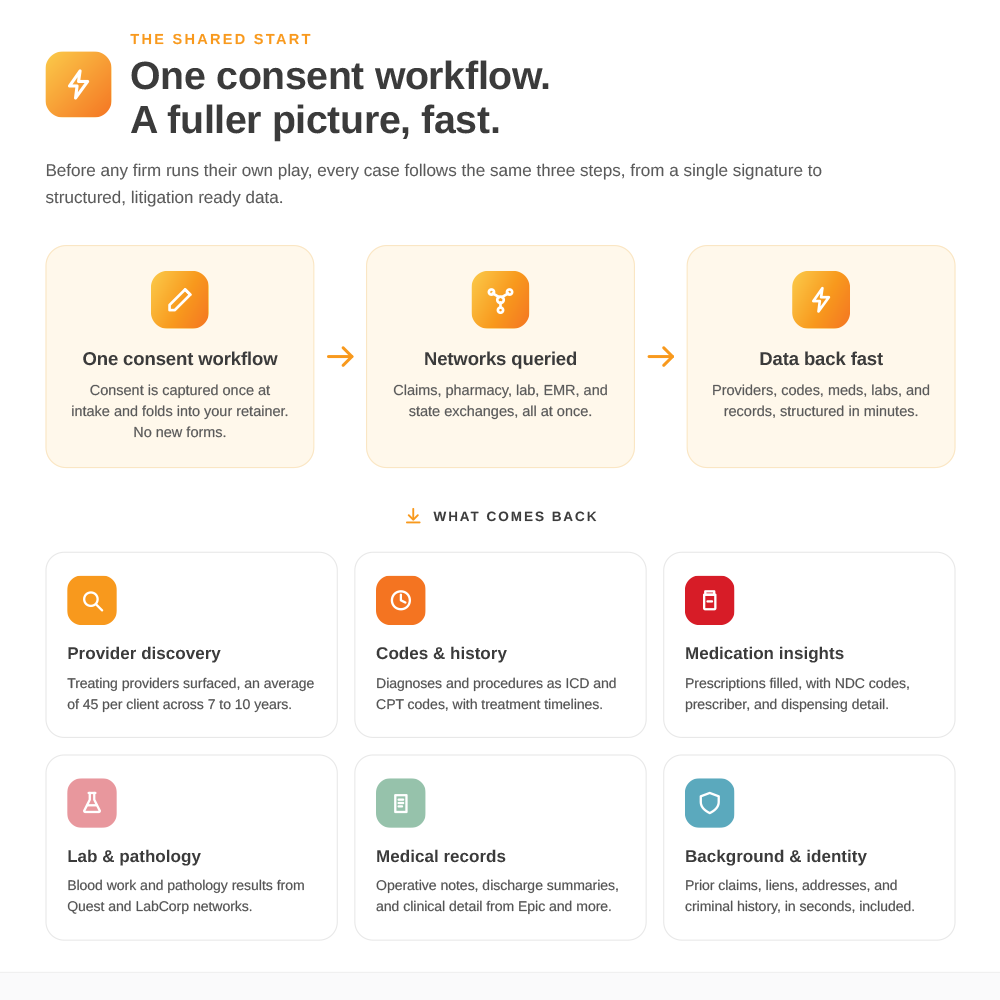
Two questions decide most Covidien cases early. First, does the surgical history support the claim? Claims data returns hernia repair and revision procedures with CPT codes and dates of service, along with complication diagnoses: infection, obstruction, adhesion, recurrence. That establishes the arc from implant to complication to revision without waiting on the client's memory or a stack of record requests. A claimant whose data shows a repair in 2017, obstruction diagnoses in 2021, and a revision in 2022 has a coherent story. A claimant with no revision on record prompts a different conversation.
Second, where does the product identification live? More places than it used to. On a recent mesh docket, product IDs came back digitally through patient-authorized individual access, inside the CCDA clinical documents returned for claimants. Where the digital return doesn't surface the brand, provider history tells you exactly where to look: instead of sending ten speculative record requests, your team sends two or three operative note pulls aimed at the facilities where the implant and revision actually happened. The result is a docket where workup dollars go to the cases the data already supports.
(Any client described here is composite and illustrative, not a real case.)
What the data will not settle
Honesty about the edges protects both your firm and the people you sign. Digital health data is digital-first, not digital-only. Claims and pharmacy data, queried together, return data on roughly sixty percent of clients, and repairs performed before the mid-2000s may predate digital records entirely, which matters in a litigation where some implants are decades old. Structured data confirms procedure and diagnosis codes with dates, not billed dollar amounts, and product identification doesn't come back digitally for every claimant, so some operative notes still need to be pulled. This complements traditional retrieval rather than replacing it.
One more point specific to careful practice: an AI-generated case summary is a navigation aid, not evidence. The records behind it are the evidence, and those are what belong in the file. And because this verdict is days old as of this writing, with an appeal promised, confirm the current posture before you rely on any of it. None of this is legal or medical advice.
A verdict is a signal, not a settlement
An $88 million verdict will pull a wave of new claimants toward this litigation, and the language around moments like this tends to lean hard on speed and scale. It's worth remembering what sits underneath the docket. These are people who trusted a routine surgery and ended up losing part of their bowel to fix it. The firm that screens them with care, that confirms the surgical history and aims the product identification work before making promises, is the firm that serves them best and builds the inventory that holds up when settlement talks resume. If your firm is weighing Covidien intake, it's worth seeing how the data comes back on a handful of real client timelines before you decide how far to lean in.
.svg)