

Every firm that has tried to grow volume runs into the same wall. The cases come in faster than anyone can properly vet them, and the instinct is to loosen the filter to keep the pipeline full. That works for exactly as long as it takes the weak cases to mature. Then the cost shows up: staff hours sunk into files that should never have been opened, settlements that came in low because the evidence never supported more, and the occasional case that comes apart in deposition because something nobody checked was sitting in the record the whole time.
The firms that scale without breaking case quality have figured out something the others haven't. Case selection is not a separate discipline from building the case. It is the first act of building the case. The moment you accept a file, you have committed to whatever evidence that client's history will eventually yield, whether you have seen it yet or not. So, the real question at intake isn't "does this client seem credible." It's "what does the evidence actually say, and is it the evidence of a case we can win." Selecting cases is selecting evidence. The firms that treat it that way are the ones that grow without diluting.
The most expensive decision a firm makes
There's a hard truth underneath firm economics that's easy to look past when the pipeline is full: the most expensive decisions a firm makes are the ones it makes without data. A case accepted on a gut read and a clean-sounding story costs nothing on the day it's signed. It costs a great deal six weeks later, when ordered records finally arrive and the file looks nothing like the one you took on. By then the staff time is spent, the attorney attention is committed, and the realistic choices have narrowed to settling thin or absorbing the loss. There's a human cost too: a claimant has spent those weeks believing their case is moving, when the evidence was never going to carry it.
This is the structural flaw in the traditional intake model. The information that should drive the accept-or-decline decision arrives weeks after the decision has already been made. Retrieval runs on its own slow clock, thirty to sixty days per provider, and it can only reach providers you already know to ask about, which means the client's own memory sets the ceiling on what you learn. You are, in effect, selecting cases blind and finding out what you bought after the window to act on it has closed.
Screening on evidence, at the speed of intake
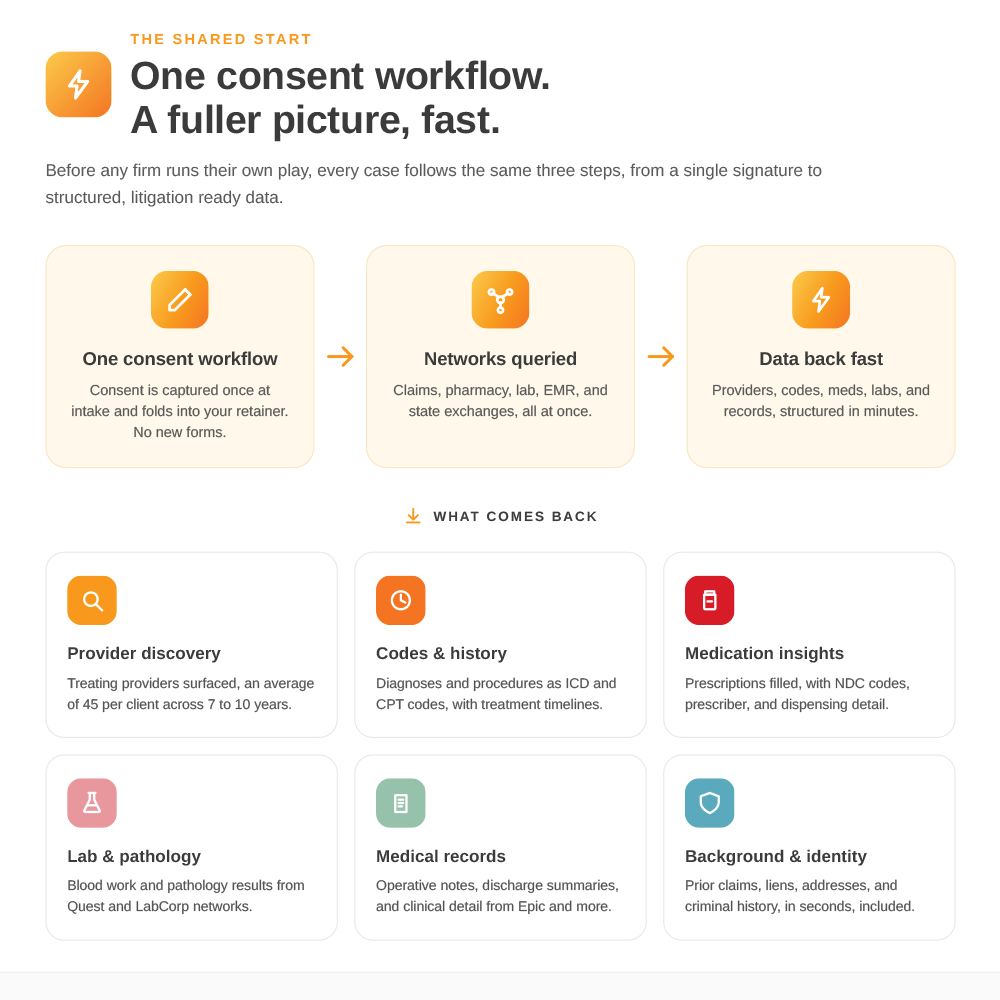
What changes the math is being able to see the evidence before the commitment, not after. Roughly 85 percent of health data in the United States is now digital, moving through national digital networks rather than sitting in any one provider's files. With a single patient authorization, a query runs against those networks directly and returns structured data in minutes: a provider list, diagnosis and procedure codes, medication history, and treatment timelines. Most sources come back in about five minutes, with the full range running five minutes to five days. That's fast enough to inform the intake decision itself, rather than confirming or regretting it later.
The provider list is the natural front-line screen, and it's the lowest-friction place to start. It averages around 45 providers per client, with specialties and dates of service, and it takes one signature. For a firm screening volume, the spread of specialties is a fast viability signal on its own. If a claimed injury should have generated orthopedic and emergency treatment and the history shows neither, that tells you something before you spend a dollar of staff time. If the story is a back injury and the record is all unrelated care, that's a flag worth catching at intake rather than at demand.
From there, the deeper sources confirm what the screen suggests. Claims clearinghouse data returns diagnosis and procedure codes at an 85 to 90 percent hit rate, so you can verify that the injury you're being told about is the injury the record documents. Pharmacy data, at close to 100 percent for insured clients, confirms medication and treatment history and surfaces the pre-existing picture. For mass tort intake, the same approach runs at scale: configure the qualifying diagnosis codes, NDC codes, and exposure criteria for a given tort, then screen an entire docket against them, flagging the cases that qualify and filtering out the ones that don't. One firm screened 6,000 Roundup claimants this way; another ran 8,000 AFFF claimants, with lab data confirming exposure. The principle is identical whether you're vetting one PI file or ten thousand tort claimants: select on evidence, not on assertion.
Screening out what shouldn't get in
Volume growth carries a second risk that firm leaders feel acutely, especially anyone sourcing leads they didn't originate: weak claims that pass a surface read. The usual way to catch them is calling a records department and hoping, which doesn't scale and doesn't reliably work. Evidence-based screening does. The provider-list spread is a fast plausibility check, and claims and pharmacy data deepen it where the stakes warrant.
The results can be decisive. In one set of lead-vendor evaluations, every claimant submitted was disqualified on the data, in some cases because the billing codes showed a different diagnosis entirely, the kind of distinction (one neurological condition versus another) that determines whether a case qualifies for a given tort at all. In a personal injury matter, a firm screening a client found an undisclosed criminal history shortly before trial, reassessed its strategy, and resolved the case rather than walk into it. None of that is about doubting injured people. It's about committing the firm's time and the claimant's hopes only to cases the evidence can actually carry.
What it doesn't do, and why that still works
Honest scope matters most in a decision this consequential. This is digital-first, not digital-only. When claims and pharmacy data are combined, you'll see useful history for roughly 60 percent of clients, which means some clients and some providers, particularly small private practices and anyone not yet connected to digital networks, won't fully surface. The data returned is structured records and clinical documents, not the certified narrative chart you'll ultimately put into evidence, and it doesn't include billed dollar amounts. It complements traditional retrieval rather than replacing it.
For case selection, those limits are easier to live with than they would be at trial, because screening is about direction, not finality. A clear viability signal on 60 percent of intake, available in minutes, is a real improvement over a gut read on 100 percent of intake with the truth arriving six weeks later. And for the cases you do accept, the same screen has already told you where to aim retrieval, 2 or 3 targeted requests instead of 10 to 20 on guesswork, so the selection decision and the evidence build become the same motion.
The bottom line
A firm grows on the quality of the cases it accepts, and it accepts those cases at intake, on whatever information happens to be in front of it at that moment. The opportunity is simply to put better information in front of it. When case selection becomes evidence selection, when the accept-or-decline call is made on the medical record rather than on the client's recollection, a firm can take more cases without taking worse ones, and spend its capacity on the claimants it can actually help.
Talk to your team about how this changes intake. Specifically, about which cases your firm accepted last quarter that the evidence would have told you to decline.
.svg)

.png)