
.png)
Every firm owner knows the version of this moment. A client sits across from your intake team, does their honest best to remember every doctor they have seen, and gives you a list. It feels complete. Weeks later, a record comes back that points to a provider nobody mentioned, or a deposition takes a turn because the defense knew something your file did not. It was never that your client lied. People are simply poor historians of their own care.
That gap between what a client remembers and what actually happened is the thread running through our recent conversation on Grow Your Law Firm, Ken Hardison's podcast for firms trying to grow the smart way. SettLiT's founder, James Bateman, joined Ken to talk through what changes when a firm can see the full digital picture of a client's medical history early, and why that matters more every month. Here are a few of the ideas worth carrying into your own practice. The full episode is worth your time, and there is a link to it at the end.
Forty-five doctors nobody wrote down
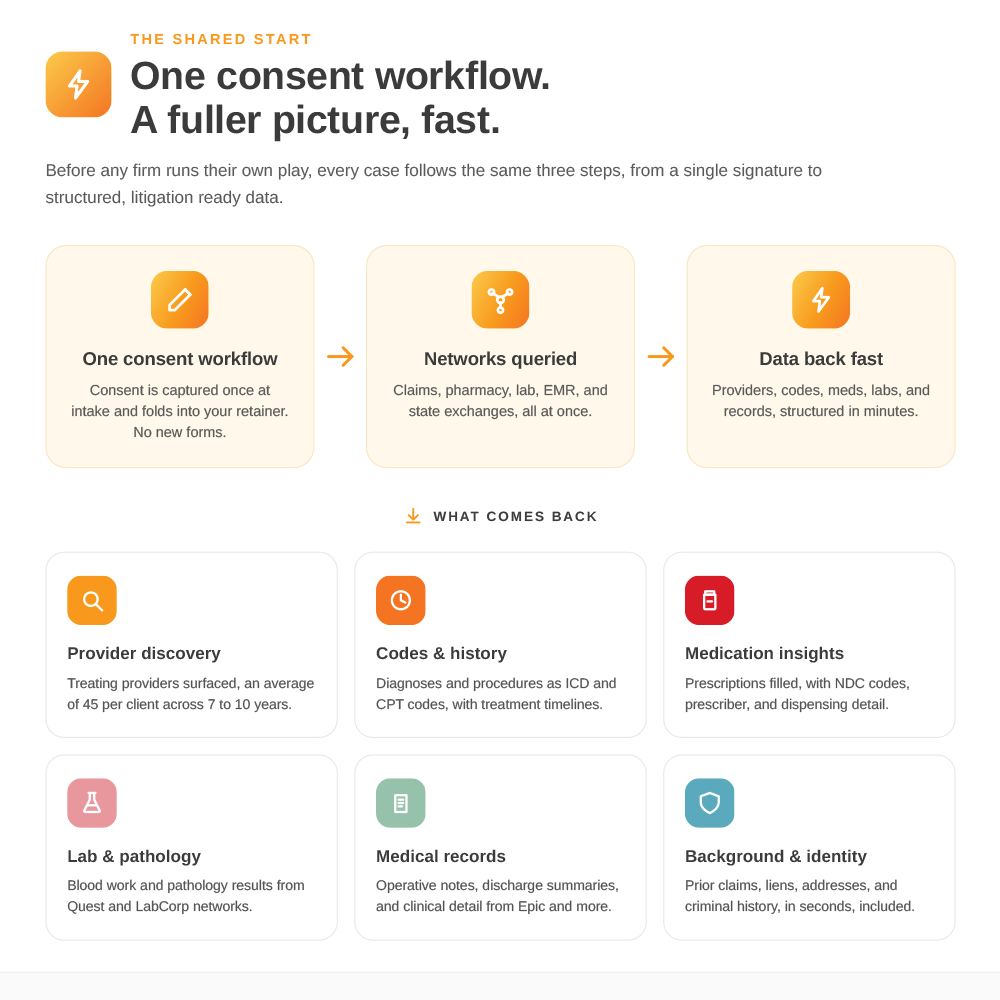
One number from the conversation tends to stop people. Looking back across twelve months of how firms are using digital health data at intake, and comparing what clients reported on their questionnaires against what the databases actually showed, the average client had roughly 45 treating providers they had not disclosed. Not because anyone was hiding anything. Walk-in clinics, a radiologist read months ago, a pharmacy across town, a specialist seen once and forgotten. It all adds up, and none of it lives in a client's memory the way it lives in the record.
The practical shift is small and powerful. Instead of asking a client "who did you see," you can sit with the list already in front of you and ask better questions. The chiropractor probably is not relevant to the case. The neurologist might be everything. Now the intake conversation is about deciding which records to chase, not guessing whether they exist.
The point is not to replace your retrieval team
It is easy to hear "digital health data" and assume it means the end of record retrieval. It does not, and Bateman was direct about that on the show. Think of this as a new layer that sits alongside the work your team already does, not a swap. Digital data is fast and structured, and it is excellent at telling you where the records are and whether a case holds up. It is digital-first, not digital-only. Some providers are not in the networks yet, coverage varies, and you will still send traditional requests for narrative notes, certified copies, and the smaller private practices that have not gone digital.
What it does remove is the wasted motion. No more sending a request to a provider your client thought they saw, only to get a "no records found" letter back weeks later after you have already paid to chase a document that was never there. When you know what exists before you go looking, retrieval gets aimed instead of scattered.
The defense has usually seen the file first
Ken raised the point that most trial lawyers feel in their gut: insurers and defense counsel have been working from connected health data for years. Most of the medical picture in this country is already digital, and the side with claims relationships has been quietly using it to find prior injuries, treatment gaps, and undisclosed providers before a plaintiff firm has sent its first request.
That is the asymmetry the conversation kept circling back to. Getting blindsided at a deposition is not a failure of preparation. It is usually a failure of access. Closing that gap early, before case theory is set, is less about gaining an edge and more about not walking in a step behind.
Compliance is the whole game, not a footnote
Any time the topic turns to health data, the room gets nervous, and it should. Bateman spent real time on how this access is earned rather than scraped. It runs on verified client identity and signed patient authorization, and it is built to operate inside the national health data frameworks, not around them. The episode also gets into how to vet any vendor holding this kind of information: check references, look for real corporate backing and independent oversight, and lean on industry standards like the National Legal Vendor Association's vetting process. This is sensitive data, and the firms that treat it carefully are the ones protecting their own bar cards.
One encouraging example from the episode is the statewide partnership with the Nevada Justice Association, which opened compliant, association-backed access to state health data for its member attorneys. It is a preview of how this kind of access can be built deliberately, state by state, with the people who actually represent claimants at the table.
From a document mindset to a data mindset
The through-line Bateman kept returning to is a shift in how firms think about evidence. Most practices still run on documents. They scan, upload, and feed PDFs into whatever tools they use, and they pay by the document to do it. He made the case that the firms pulling ahead are moving to structured data instead, because that is what makes their other tools genuinely useful. As he put it, AI is only as good as the data underneath it. Feed it a clean, structured picture of a client's history and the decisions get sharper. Feed it scanned paper and you get more of the same.
Ken and James also traded honest notes on where the industry really is. Most firms are still early, and plenty are waiting to see what settles before they move. That is a reasonable instinct. The counterweight, and Bateman said this plainly, is that today is the worst this data will ever be. The networks grow every month, and access that came back thin a year ago can come back full now.
Where earlier validation is heading
Maybe the most forward-looking part of the conversation was about pressure coming from the bench. Judges overseeing large dockets are increasingly asking attorneys to validate cases earlier, because they keep watching claims travel deep into the process before someone discovers the case was never viable. That wastes everyone's time. The answer both host and guest kept landing on is to move the picture up front: run the medical background check at intake, understand the case on day one, and build a strategy without major blind spots waiting downstream.
It is worth being clear-eyed about the limits, which the episode does not gloss over. Digital data has gaps, it does not return billed dollar amounts, and it is a strong head start rather than a complete history. Used that way, as the early read that shapes everything after it, it changes how a case feels from the very first conversation.
Listen to the full conversation
There is far more in the episode than fits here, including the cost math, a story about a deposition saved with five days to spare, and Ken's own take on where firms are heading over the next few years. If any of this sounds like the grind your team knows too well, it is worth an hour of your time.
You can listen to the full Grow Your Law Firm episode with Ken Hardison and James Bateman here: How Better Medical Data Helps Firms Validate Cases Faster. And if it leaves you curious about what the digital picture would show on your own files, it is worth seeing for yourself at settlit.com.
.svg)