

If you run a personal injury practice in Nevada, you already know the geography problem. A client treats at a hospital in Las Vegas, follows up with an orthopedist in Henderson, gets imaging somewhere off the Strip, and then mentions, three weeks in, that they once went to urgent care in Reno after a fall they forgot to bring up. Each of those stops is a separate request, a separate wait, a separate chance that something important arrives after you have already set your strategy. Your intake team spends its days chasing records that move at the speed of fax machines, and your case decisions get made on a picture that is always a little behind.
That picture is starting to change, and Nevada is one of the first places it is changing in away that touches the whole state at once.
What "statewide" actually means here
Most health information exchanges are regional. They cover a network of hospitals in one metro, or a cluster of systems that happened to join together. Nevada is different. Nevada's statewide health information exchange covers the acute care hospitals across the state rather than a single city or system. When a query runs against it, you are not asking one hospital whether it has your client. You are asking the state.
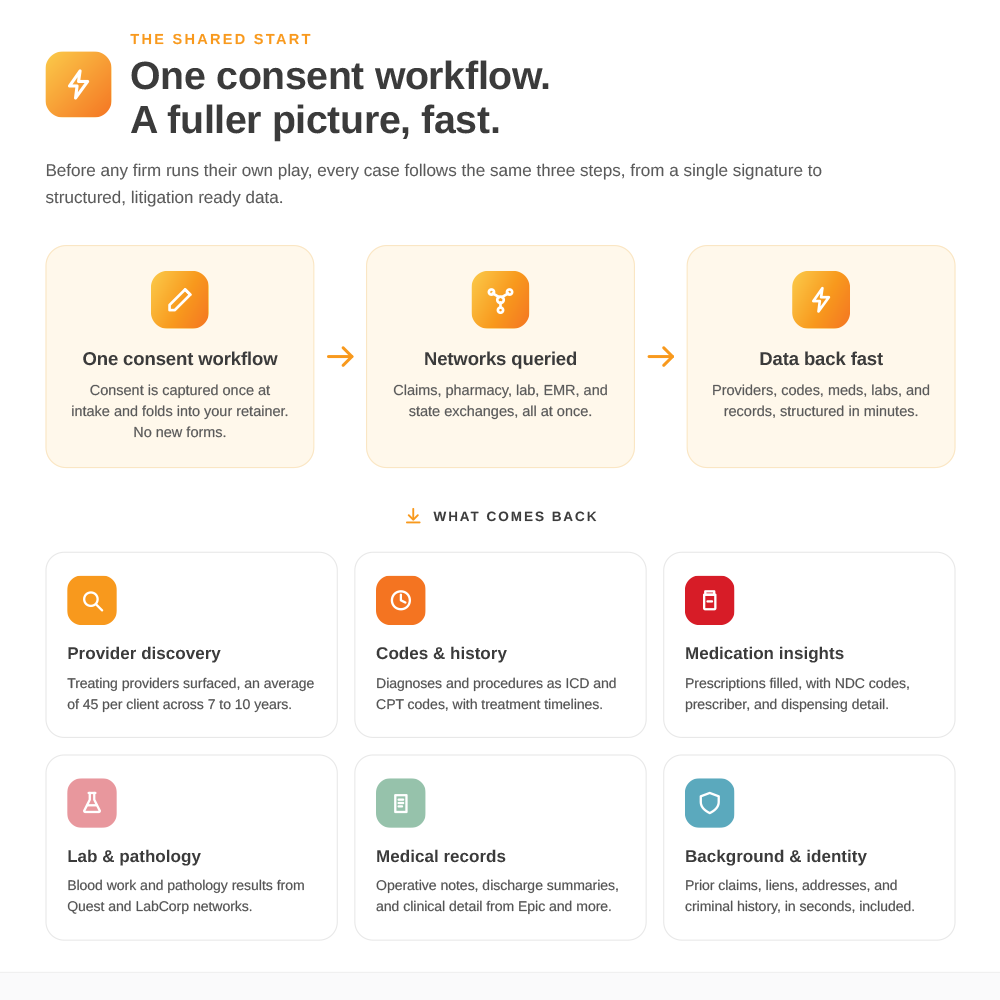
The practical effect is speed and breadth at the same time. A single patient-authorized query against the Nevada exchange can return hospital visits, urgent care encounters, specialist records, and clinical summaries from facilities across the state, often in as little as twenty minutes, for a flat fee. You are no longer guessing which Nevada hospital holds the record you need. You see the footprint, and then you decide where to go deeper.
For a firm leader, that is less a records story and more a pipeline story. The question stops being "how long until the records come in" and starts being" what do we want to know before we commit."
Why earlier visibility reshapes case selection
The most expensive decisions a firm makes are the ones it makes without data. You take a case that looks clean at intake. The story is credible, the client is sympathetic, the timeline makes sense. Six weeks later the records start arriving and the picture is different than it looked. A prior injury to the same body part. A treatment gap that undercuts the damages narrative. A provider nobody mentioned. By then you have invested staff hours, vendor costs, and attorney attention into a case that no longer resembles the one you signed.
Statewide coverage compresses that timeline. When the digital picture is available at intake, in minutes, your case selection improves before resources are committed rather than after. You can see whether the treatment footprint matches the story. You can spot the prior episode early, when it is still strategy and not yet a surprise. The provider list alone, which surfaces an average of around forty-five providers per client with specialties and dates, often tells you where to focus and where to be cautious before you have ordered a single full chart.
(The scenario above is composite and illustrative, not a real client.)
This matters most for the firms thinking about scale. Adding volume without adding visibility is how case quality slips. Statewide data at intake lets a Nevada firm grow its book without flying blind on each new file.
It also changes the day for the people doing the work. The paralegal who used to spend mornings on hold with hospital release-of-information desks, the intake coordinator tracking which of a dozen requests have come back, the records clerk reconciling partial returns: their load is the load that statewide coverage actually lightens first. When the footprint shows up in one query, the team is no longer chasing the existence of records. They are working from them. That is a quieter benefit than a courtroom win, but over a year of files it is the one your staff will feel most, and it is part of why early visibility tends to pay for itself in time before it ever shows up in a settlement number.
The defense has been working from connected data for awhile
There is a quieter reason this shift matters. Roughly eighty-five percent of health data in the United States is digital, and it has been for more than a decade. Defense counsel and insurers have been drawing on connected health data, claims systems, and pharmacy records for years to find prior conditions, treatment gaps, and undisclosed providers, frequently before a plaintiff firm has sent its first request. When that information surfaces in a deposition, the plaintiff side is responding to a picture the other side already had.
Statewide digital access narrows that gap. It is not a trick and it is not a workaround. It is access to the same kind of connected health data the other side has been using, available to you at the start of the case instead of the middle. For Nevada firms, the state exchange is one of the clearest examples of that access becoming routine rather than exceptional.
What it will not do, and why that is worth saying plainly
Statewide coverage is powerful, and it is not everything. Honesty about the edges is part of using it well.
The approach is digital-first, not digital-only. It reaches what lives in connected networks, which is a large and growing share of care, but not the small private practice that still runs on paper or the certified narrative chart you will sometimes need for the file. Claims and pharmacy data, queried together, return data on roughly sixty percent of clients, so it is a strong head start rather than a guaranteed complete history for every person. And the data returns clinical and billing information, including codes and dates of service, not the actual billed dollar amounts, which still come from the providers and the bills themselves.
The honest way to frame all of this is complementary, not replacement. Statewide digital access does not retire your existing process. It points it. Instead of sending ten or fifteen requests and hoping, your team can see the footprint first and send two or three that actually matter. The grind gets smaller, and the misses get rarer.
What this means for a Nevada firm right now
The headline is simple. For the first time, a Nevada personal injury firm can get a statewide view of a client's hospital and clinical history at the start of a case, in minutes, for a predictable cost, with the client's authorization. That changes what you can know at intake, which changes which cases you take, which changes how confidently you can grow.
It will not answer every question, and it is not meant to. What it offers is a clearer starting point: fewer surprises late in a case, less time lost chasing the wrong providers, and a pipeline built on what the data actually shows rather than what a client happened to remember. If your practice runs on Nevada cases, that is worth seeing for yourself. You can look at how a statewide query comes back, and decide what an earlier, fuller picture would be worth to the cases already sitting in your intake queue.
.svg)