

Picture the client who calls your firm. For years she was told she had stubborn eczema. She tried the creams, then the pills, then a newer biologic that finally seemed to calm her skin. The relief lasted a while. Then the patches came back, deeper this time, and a biopsy came back with a word no one expected: lymphoma. By the time she understands what happened, she has questions no settlement can fully answer, and she is looking to a firm to help her make sense of it.
That is the human center of the litigation now forming around Dupixent. Before it becomes a docket and a screening spreadsheet, it is people who believe a drug they trusted may have masked or accelerated a cancer. How your firm meets them at intake, and how carefully it sorts the cases it can stand behind, matters as much here as in any tort you have handled.
What just happened
On June 5,2026, the U.S. Judicial Panel on Multi district Litigation centralized the federal Dupixent lawsuits into a new MDL: In re: Dupixent (Dupilumab) ProductsLiability Litigation, MDL No. 3180, assigned to the District of New Jersey before Judge Zahid N. Quraishi. The order moved an initial group of about fifteen cases, with several more tag-along actions already identified.
The path thereis worth knowing, because posture shapes strategy. Plaintiffs filed the consolidation motion in February 2026 and asked for the Northern District ofGeorgia. The manufacturers, Sanofi and Regeneron, agreed that an MDL made sense but argued for the Southern District of New York, near their headquarters. ThePanel landed on New Jersey. For firms weighing whether to take Dupixent cases, the practical signal is simple: this is early. A freshly created MDL is the ground floor, before bellwether selection, before a census order, before the case management plan hardens. The firms that build a clean, well-substantiated inventory now are the ones positioned when the litigation matures.
The claim, in plain terms
The core allegation is that Dupixent, a widely prescribed biologic for atopic dermatitis and several other conditions, may cause or accelerate rare T-cell lymphomas, most commonly cutaneous T-cell lymphoma. CTCL includes subtypes such as mycosis fungoides and Sezary syndrome, and some filings also reference peripheralT-cell lymphoma. The legal theory centers on failure to warn: that the companies knew or should have known of a possible link and did not adequately tell patients or physicians.
It is worth being precise about where the science sits, because your intake team will field clients who have read more certainty into the headlines than the record supports. As of mid-2026, the FDA has been evaluating the question after a body of adverse-event reports, but it has not ordered a recall, and the current prescribing information does not warn of CTCL. The manufacturers dispute causation. The medical literature is genuinely divided between two explanations: that some patients had CTCL all along and it was misdiagnosed as eczema, or that the drug's effect on the immune system unmasked or sped up an existing clonal process. Those competing theories are not a footnote. They are the heart of what this litigation will fight about, and they shape which cases are strong.
Why this one is hard to screen
CTCL is one of the most difficult cancers to separate from severe eczema, especially early.Mycosis fungoides often begins as flat, scaly patches that partly respond to steroids, which looks a great deal like the atopic dermatitis Dupixent is prescribed to treat. Patients frequently improve at first, then progress, and the cancer is sometimes only recognized after the drug is stopped. That overlap is exactly what makes a careful intake matter.
It also makes the evidence scattered. A single client's story may run through a primary care doctor, one or more dermatologists, a biopsy at an outpatient pathology lab, an oncologist, and a specialty pharmacy that dispensed the drug. Clients rarely remember all of it, and the timeline that matters most, the sequence from atopic dermatitis diagnosis to Dupixent use to lymphoma diagnosis, is precisely the thing memory blurs. Screening a docket of these cases on client recollection alone is how firms end up carrying cases that do not hold up and turning away ones that would.
How firms can screen and substantiate quickly
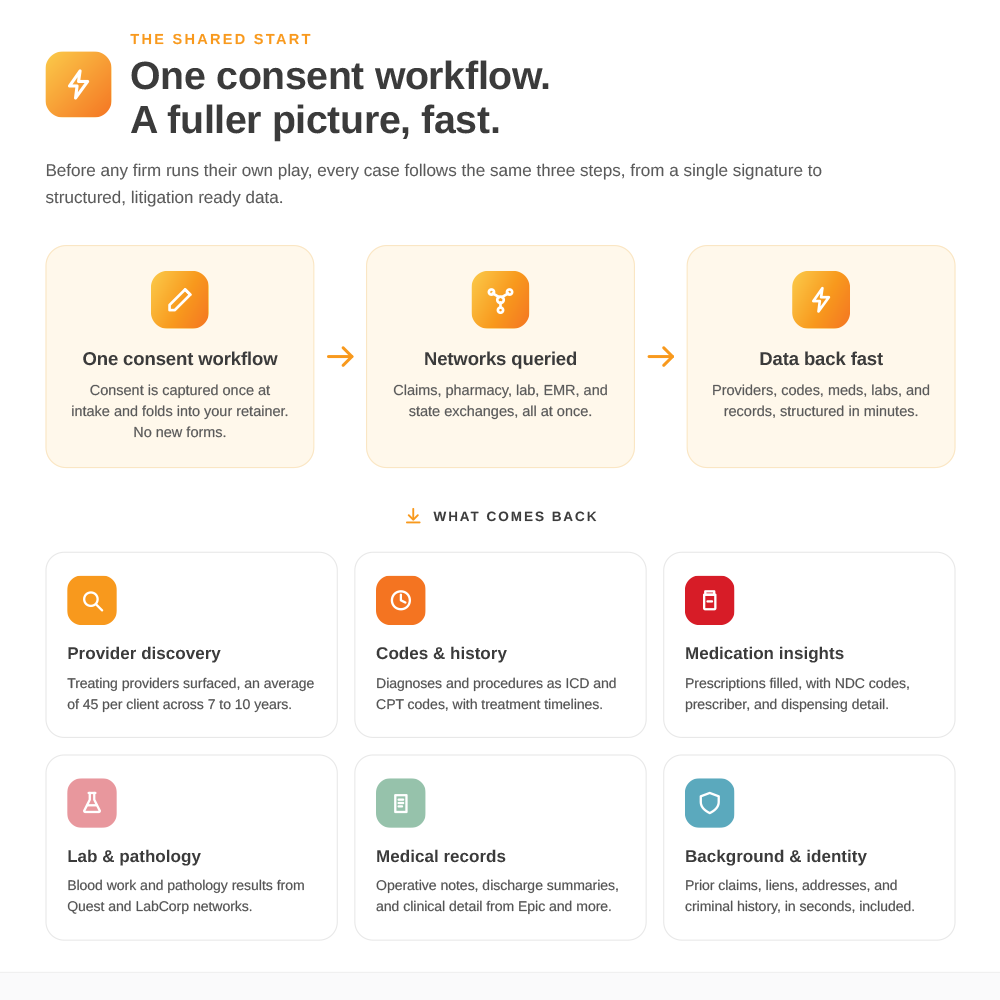
This is where structured digital health data earns its place, not as a shortcut around the work, but as a way to take the guesswork out of it and lighten the load on the people doing the screening.
Two questions decide most of these cases early. First, did the client actually use Dupixent, and for how long? Because Dupixent is dispensed through pharmacies, including specialty pharmacies, fills generally appear in pharmacy network data with the drug's NDC codes and dispensing dates. That establishes exposure and duration without waiting on the client to find old boxes or call the pharmacy. Second, what is the actual diagnosis? Claims data carries the diagnostic codes, so areal CTCL, mycosis fungoides, or Sezary diagnosis can be confirmed rather than assumed, and a different lymphoma or a benign dermatitis can be ruled out before staff time goes in. The same pull surfaces the treating providers, dermatology and oncology among them, with dates, so you can see the care path at a glance.
The timeline is the part that usually has to be reconstructed by hand, and it is the part that makes or breaks causation. With pharmacy fills, diagnosis codes, provider history, and pathology results lined up against each other, the sequence becomes visible: the eczema diagnosis, the start of Dupixent, the months of apparent improvement, the later lymphoma diagnosis. That picture tells you quickly which clients have a coherent story and which do not. For the cases that qualify, the same underlying records support a proof-of-injury report with signed certification, the kind of documented, defensible output firms have relied on in other torts. Used this way, the goal is not volume for its own sake. It is a cleaner inventory and fewer surprises later.
(Any client described here is composite and illustrative, not a real case.)
What the data will not settle
Honesty about the edges protects both your firm and the people you sign. Digital health data is digital-first, not digital-only. It reaches what lives in connected networks, which is a large and growing share of care, but not every paper chart from a small dermatology practice or the full narrative pathology report you will sometimes need for the file. Claims and pharmacy data, queried together, return data on roughly sixty percent of clients, so it is a strong head start rather than a guarantee for every person. It confirms diagnostic and dispensing codes and dates, not billed dollar amounts, and it complements traditional retrieval rather than replacing it.
One more point specific to careful practice: an AI-generated case summary is a navigation aid, not evidence. The records behind it are the evidence, and those are what belong in the file. And because this MDL is days old as of this writing, the posture can move quickly. Confirm the current status before you rely on any of it. None of this is legal or medical advice.
The ground floor is also a responsibility
A new MDL is an opportunity, and the language around these windows tends to lean hard on speed and scale. It is worth remembering what sits underneath the docket. These are people who trusted a treatment and are now facing a cancer diagnosis, and the firm that screens them with care, that confirms the real diagnosis and the real exposure before it makes promises, is the firm that serves them best and builds the steadier inventory. The fastest way to do right by both is to see the full picture early. If your firm is weighing Dupixent intake, it is worth seeing how the data comes back on a handful of real client timelines before you decide how far to lean in.
.svg)