

Behind every line on a mass tort docket is a person who was hurt and is waiting. They are waiting to find out whether their case qualifies, waiting through filing deadlines they do not fully understand, waiting for a resolution that may be years away. The slower and blunter your qualification process, the longer real people wait for what they are owed, and the more likely it is that a legitimate claimant gets stuck behind a backlog of cases that never should have entered it in the first place.Getting qualification right is not only an operational discipline. It is how a firm keeps faith with the injured people who trusted it.
That is the frame worth holding as the mechanics get technical, because the mechanics have changed a great deal. In 2026, the firms running the cleanest dockets are not qualifying mass tort cases the way they did even three years ago. They are not waiting on box after box of paper to confirm an injury that a structured data query could verify in minutes, and they are not carrying thousands of unscreened intakes hoping the bad ones shake out before a bellwether. They are screening the docket against tort-specific criteria upfront, confirming injury and exposure with digital health data, and filtering out the cases that do not qualify before those cases consume time, money, and a claimant's hope.
Why qualification became a data problem
Mass tort qualification has always asked two questions of every claimant. Did they have the qualifying injury, and were they exposed to the product or substance at issue?Historically, answering those questions meant ordering records and reading them, claimant by claimant, which does not scale to a docket of thousands. So, firms leaned on intake questionnaires and lead-vendor representations, and lived with the consequences: dockets padded with cases that turn out to have the wrong diagnosis, the wrong exposure window, or no medical evidence at all.
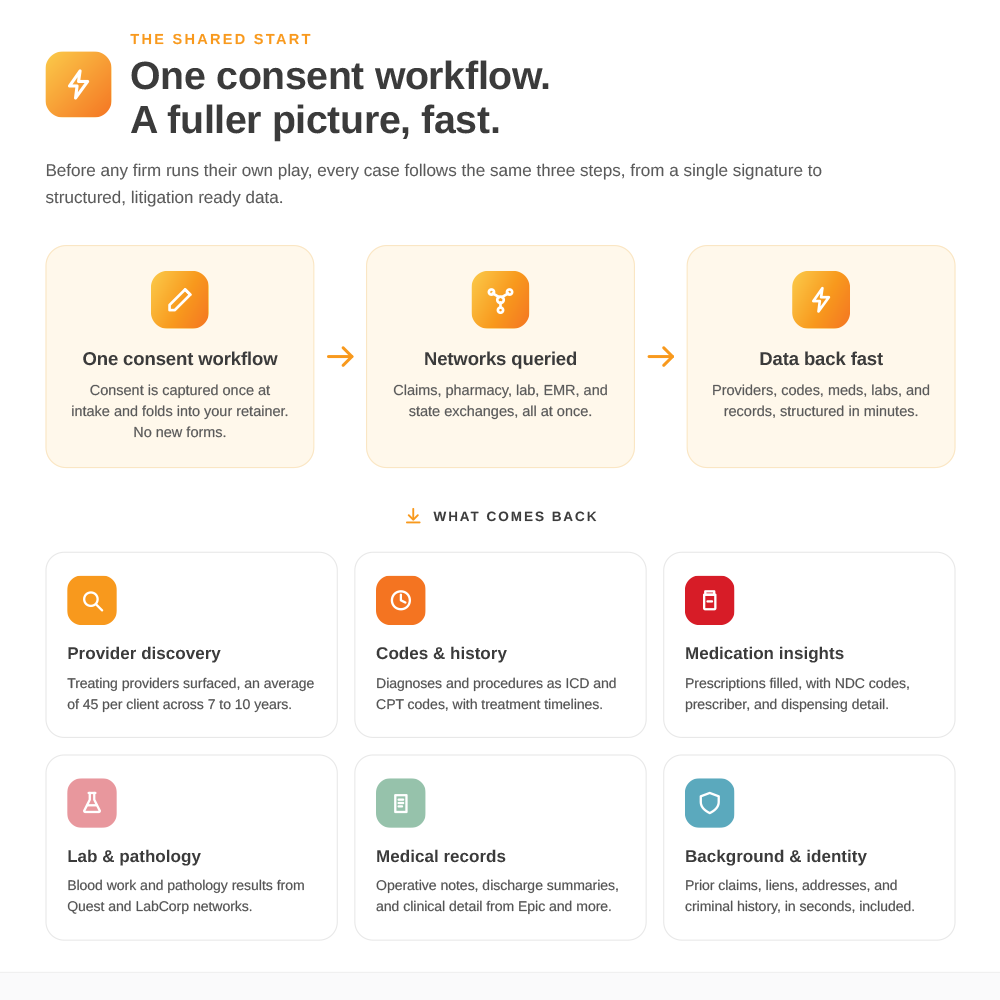
The shift is that the evidence needed to answer both questions is now largely digital and queryable at scale.Claims clearinghouse data returns diagnostic codes, procedure codes, and dates of service. Pharmacy benefit data returns dispensing history with NDC codes.Lab networks return pathology and blood results. Each of these can be configured to a specific tort's requirements and run across an entire docket, not one file at a time. One firm processed 350 client results over a single weekend that would have taken months the old way; another ran 6,000 cases at an average of about $105 per case for a settlement-deadline filing; batches of20,000 at once are within range. This is qualification as a data operation rather than a reading exercise.
The single most valuable thing structured data does for a mass tort team is disqualify cleanly. Billing and diagnostic codes tell you exactly what a claimant was diagnosed with, which means they tell you exactly when a claimant does not qualify. In one set of lead-vendor proof-of-concept batches, every single case submitted was disqualified, often because the diagnosis was close but wrong, the kind of distinction that sinks a case at exactly the wrong moment if it is not caught early. Removing a non-qualifying case at screening is not a loss. It is protection for the docket and for the claimants who do belong in it.
What this does not do
A serious operations leader will want the limits stated plainly, and overstating the capability would not serve a docket. Digital health data is complementary to retrieval, not a substitute for it. You will still need traditional retrieval for certified court records, complete narrative notes, and providers not yet in digital networks. Coverage is real but partial: claims and pharmacy combined reach roughly 60% of claimants when queried together, and historical data generally begins in the digitization era of the 2000s. The data returns billing and diagnostic codes, not actual billed dollar amounts. Infant and minor cases are genuinely hard; necrotizing-enterocolitis matters in particular are limited by sparse digital data and the access restrictions around minors, and birth records often sit under a mother's name. The honest framing is digital-first, not digital-only.The screen gives you a fast, structured, scalable head start; it does not retire the file you build for the cases that survive it.
The durability of all this rests on governance, which is why it can be trusted as the backbone of a multi-year docket. This is compliance-first digital health data: every query runs on patient authorization governed by HIPAA, with full audit trails, built to operate within the national health data infrastructure rather than around it.The platform's leadership co-chairs a Release of Information working group at DirectTrust and contributes to The Sequoia Project, it participates inCareQuality and CARIN advisory bodies, and it was the first to gain legal access to the Epic Chart Gateway. A SOC 2Type II audit is expected to complete in May 2026. For a mass tort practice whose cases run two to seven years to global resolution, that institutional foundation is not a nicety. It is what makes the data dependable over the life of the tort.
Back to the people on the docket
Strip away the codes and the hit rates, and disciplined qualification does one humane thing: it gets the right people to resolution faster and keeps the wrong cases from clogging the path. A claimant who genuinely qualifies should not wait behind hundreds of cases that a five-minute screen would have flagged, and a firm that disqualifies cleanly at the front protects both its docket and the injured people counting on it.The screen is just a tool, but its purpose is people getting what they are owed, sooner.
Pick your most active tort, whether that is Roundup, PFAS, or Depo-Provera, configure its injury and exposure criteria, and run a representative batch of your docket through the screen. The cases it confirms, and the ones it filters out, will tell you how much faster your qualified claimants could be moving.
.svg)